One Company, Fourteen Names: How Moving Fraud Networks Hide in Plain Sight
Noble Moving and Storage operates under at least 14 aliases. It is not an outlier. Shell company networks are the defining pattern of household goods fraud.
The Noble Moving Network
Noble Moving and Storage, a New Jersey company owned by Joseph Hannouch, operates under at least 21 known aliases: American Choice Van Lines, Lucrative Van Lines, Ryder Relocation, Packrite Movers, Lets Move America, Easy Moving, AMM Trucking LLC, Cross State Van Lines, Prime Moving and Storage, Movers and Packers Relocation Specialists, Star Line Trucking, Primeline Van Lines, Space Moving, Four Seasons Movers LLC, Certified Movers LLC, Selective Van Lines, Moving Services Corp, Reliable Movers USA, Superior Moving Systems Inc, No Hassle Moving Corp, and Movone Inc. Each name appears as a separate entity in public records. A consumer researching 'Packrite Movers' would find no connection to 'Lucrative Van Lines' or 'Noble Moving and Storage' in any FMCSA database. The corporate filings trace back to the same principals and the same addresses, but FMCSA's registration system treats each name independently, with its own complaint history starting at zero. Noble's principals are connected to Howards Vanlines (USDOT 4391903), whose corporate principals Karim Hassan and Ahmad Riyad Alomari appear to include Hannouch and his wife, Farah Al-Ibrahim, a convicted moving fraud conspirator who received new FMCSA broker authority while still on criminal probation.
The network's next venture appears to be Victory Moving and Storage (DOT 4563339), registered in Hackensack, NJ at an apartment complex address by Fady AlIbrahim, Farah's brother. The company has FMCSA authorization but has not yet launched operations as of August 2026. The registration pattern has evolved over time: Farah and Joseph originally filed companies in their own names, then shifted to filing in employees' names with 'also known as' filings linking back to Moving Systems Inc, and now appear to be registering companies in the names of drivers who receive a cut of each move for lending their identity to the filing. The network also uses deliberate minor spelling variations across filings: Vanline vs. Vanlines, Howard's vs. Howards, with and without apostrophes, plural and singular forms. Whether sloppy or intentional, these variations make entity searches harder across databases that rely on exact name matching.
This Is Not an Outlier. This Is the Model.
The Noble alias chain is not unusual. It is the standard operating model for moving fraud in the United States. Federal criminal cases spanning two decades document the same structure repeatedly. In the 2003 Majesty Moving case (S.D. Florida), Yair Malol operated six interchangeable companies: Majesty Moving and Storage, Apollo Van Lines, America's Best Movers, First Class Moving, The Movers Express, and Star Movers. All shared the same employees, bank accounts, and owner. In the companion Moving Systems case filed the same month, Simo Elbaz ran Moving Systems, AAA Van Lines, Ameri Van Lines, and SI Trucking, again interchangeably with the same staff. The 2018 Shuklin RICO case (S.D. Ohio) documented twelve defendants who 'formed several new companies and used new identities' between 2013 and 2018 to avoid detection. Eagle Moving Group (USDOT 3545015), documented in Trunk's FOIA investigation, rotated moves across at least five different carriers: Ocean Moving and Storage, First Class Movers, We-Haul Moving Services, PVL Transit Systems, and No Borders Moving. Handle With Care Moving (USDOT 3190967), whose license was revoked three times, was reincarnated as JCS Moving and Storage with the help of broker Menards Moving and Storage, and continued operating without interruption.
One Consumer, Three Companies, Three States
In June 2025, a consumer booked a long-distance move from South Dakota to Ohio through Noble Moving and Storage. The binding estimate was $6,166.80, based on a volume estimate made without a physical or virtual inventory survey. Noble then brokered the move to Moving Logistic Inc (CA, DOT 3886598), a carrier whose FMCSA authority was later revoked in November 2025. Noble has no broker authority. Its own estimate stated it 'will also coordinate and arrange for the transportation of household goods by another FMCSA-authorized motor carrier,' an admission of unlicensed broker activity in its own paperwork. Noble's contract also reserved the right to collect up to 70% of the balance before goods leave the origin state, imposed a mandatory venue clause (Essex County, NJ only), entitled Noble to 'reasonable attorneys fees, including pre-litigation fees,' and disclaimed responsibility for 'any acts or omissions of the carrier.' When the consumer requested a copy of Noble's tariff as required by federal law, Noble replied: 'Our internal tariff listing is not provided to clients.'
On moving day, Moving Logistic arrived with a 26-foot box truck with a maximum capacity of 1,600 to 1,800 cubic feet. The Bill of Lading charged for 2,200 cubic feet, a physical impossibility for the truck used. The final charge from Moving Logistic was $17,972. Delivery was then forwarded to a third carrier, Vertura LLC (FL, DOT 4219394), which added $1,500 for 'shuttle service' not identified in the binding estimate or Bill of Lading. Vertura demanded payment before unloading. Total cost: $19,472, or 316% of the original binding estimate.
The mileage was also overstated. The estimate and Bill of Lading used 1,345 miles. Google Maps shows 1,144 miles. The 17.6% mileage overstatement represents over $2,400 in overcharges from distance inflation alone.
On May 1, 2026, a retired attorney filed a formal OIG investigation request on behalf of the consumer, citing criminal culpability and multiple regulatory violations by Noble and Moving Logistic. This was the first of two OIG requests: the second, for Howards Vanlines, followed on May 29.
Shared Employees Across 'Separate' Companies
The clearest evidence that nominally separate companies are the same operation is shared personnel. In a documented 2026 case, a consumer booked a move from Florida to Missouri through Howards Van Lines after responding to a Facebook advertisement. On moving day, a different company, Moving Mania Inc (DOT 1750338, Fort Lauderdale), showed up to perform the move. The consumer had not been told a different company would handle the job.
The link was visible in the paperwork: an employee named Deb appeared on the Howards welcome email as Howards staff, and then reappeared as a Moving Mania employee during the move itself. The same person, working for two companies that FMCSA treats as unrelated entities.
Moving Mania is owned by Lior Ainuz, who also owns Fresh Start Relocation Inc (DOT 3193627) at the same Fort Lauderdale address, in an adjacent bay. The consumer's belongings were routed through Fort Lauderdale storage before delivery. The estimate was $2,690. The final cost was $7,174.
This pattern, where the company that sells the move is not the company that performs it, and where employees move freely between nominally separate entities, is the defining feature of the network model. FMCSA's registration system treats each DOT number as an independent company. The employees do not.
How the Shell Game Works
The mechanics are consistent across every documented case. Step one: register a new company with FMCSA. The application requires minimal vetting, and there is no cross-reference against the principals of previously flagged entities. Step two: operate under the new name until consumer complaints accumulate in the NCCDB and on review platforms. Step three: when the complaint volume becomes problematic, dissolve the entity or let the authority lapse. Step four: register a new company under a different name, often at the same address with the same principals, and start with a clean federal record. FMCSA's own 2012 internal policy document, 'Procedures for Investigating Potential Reincarnated/Chameleon and Affiliated Motor Carriers' (MC-ECE-2012-008), acknowledges this pattern exists. But the 2020 post-Riojas enforcement policy memo indicates that chameleon carrier investigations are among the violations 'rarely enforced in the past 6 years.' The policy exists on paper. The enforcement does not.
Why FMCSA's Database Cannot Detect This
FMCSA's registration system is entity-based, not principal-based. Each USDOT number is treated as an independent carrier or broker. There is no automated cross-reference of principals across entities. When Joseph Hannouch registers Noble Moving and Storage, then registers American Choice Van Lines at a different address with a slightly different principal name, the system creates two separate records with no visible connection. Consumer complaints filed against Noble do not appear on the American Choice record. Crash history does not transfer. Insurance violations do not aggregate. The Safety Measurement System (SMS), which FMCSA uses to identify unsafe carriers through data-driven scoring, does not track fraud patterns at all. There is no fraud score. There is no entity chain detection. A consumer checking FMCSA's SAFER database for 'Packrite Movers' would see a clean record with no complaints, no crashes, and active authority, with no indication that it is the fourteenth name used by the same operation.
The Scale of the Problem
A community-maintained database of alleged fraudulent moving companies, compiled by the administrator of a 359-member Facebook moving fraud awareness group, lists over 120 company names. Cross-referencing this list against Trunk's database revealed that many of these names are connected: aliases of the same entities, or carriers used interchangeably by the same brokers. FMCSA registration data shows 4,586 licensed household goods carriers nationally as of May 2026, with 1,347 (29%) reporting a fleet of one truck and 801 (17%) reporting two trucks. Nearly half the industry operates at a scale where a single registration can be created and dissolved with minimal overhead. In 2025 alone, 284 new HHG carriers were registered. The cost of creating a new entity is trivial. The cost of building a clean complaint history from scratch is zero. The incentive structure rewards reincarnation over compliance.
What Consumers Can Do
The alias problem is why single-source research fails. Checking FMCSA SAFER for a carrier name only tells you about that specific registered entity, not about the people behind it. Checking Google reviews only shows reviews posted under that company name. Checking BBB only shows complaints filed against that business identity. The only way to detect an alias network is to cross-reference across multiple sources and look for connecting patterns: shared addresses, shared principals, shared phone numbers, shared complaint narratives, and shared carrier relationships. This is what Trunk does for every profiled mover, checking eleven independent sources and flagging connections that no single database reveals. When we identify that Packrite Movers, Lucrative Van Lines, and Noble Moving and Storage share the same corporate principals and address, that connection is documented on every profile. When a carrier's authority is revoked and a new entity appears at the same location with the same people, we flag the reincarnation. The regulatory system was not designed to detect this. Independent verification platforms exist because the gap is structural, not accidental.
Evidence
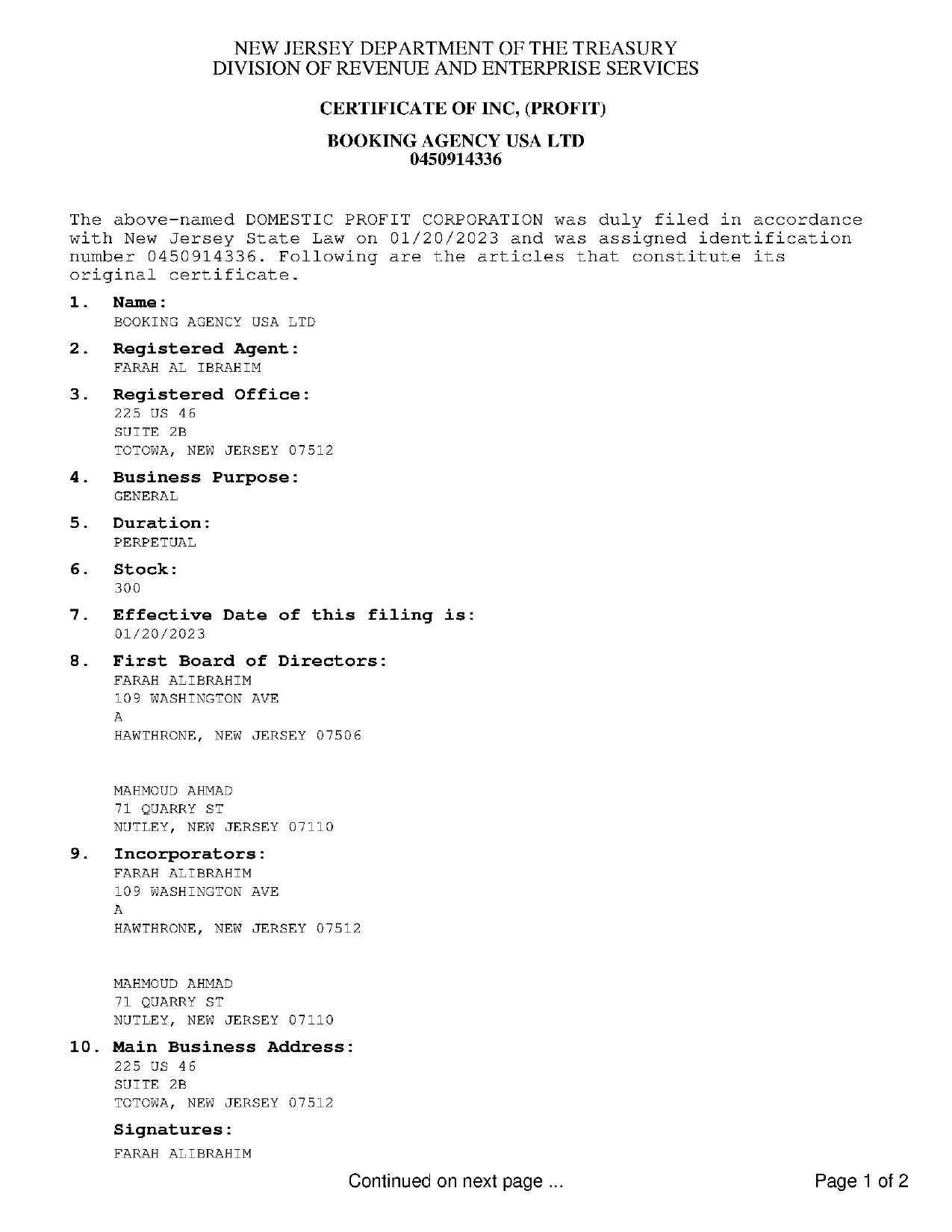
Convicted moving fraud defendant Farah Al-Ibrahim incorporated Booking Agency USA Ltd in January 2023 while still on criminal probation. The FMCSA registration system has no mechanism to flag applicants with fraud convictions.
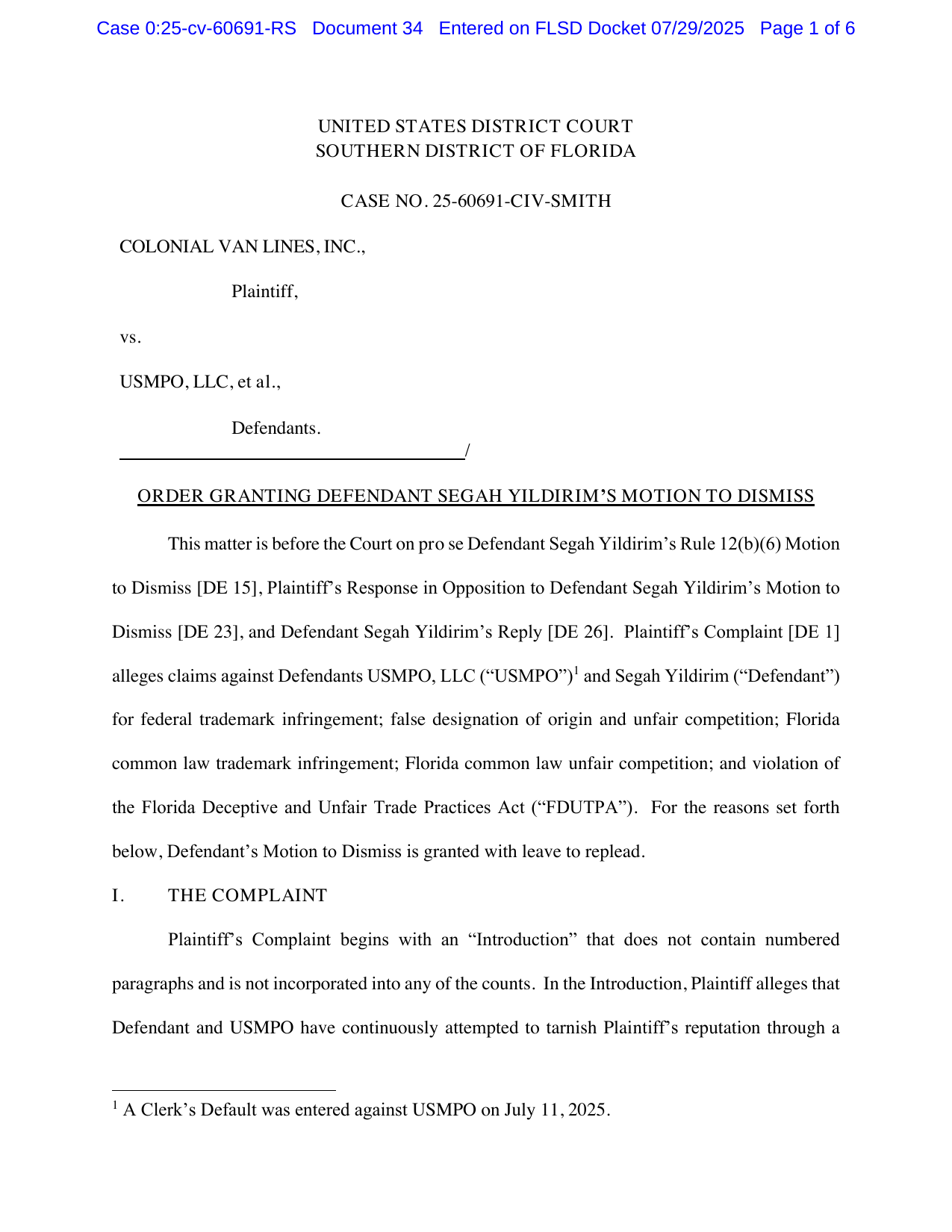
Court order dismissing Colonial Van Lines' complaint against a consumer protection platform. The same company documented in the 2012 Senate investigation into moving fraud is now using litigation to suppress consumer information.
Companies Mentioned
Contributors: John H. Vetne
Sources: FMCSA SAFER database. New Jersey Division of Revenue corporate records. Federal criminal court filings (S.D. Florida, S.D. Ohio). FMCSA NCCDB FOIA response. FMCSA internal enforcement policies (MC-ECE-2012-008, MC-ECE-2020-0001). Community-sourced alleged fraudulent moving companies database (Terry Maupin, administrator, 'Moving? Tips on moving & avoiding Moving Scams' Facebook group). FMCSA MCMIS carrier census data (May 2026).