How to Fight Back When a Mover Scams You
Most consumers don't know these options exist. Here's exactly how to use them.
1. File a Complaint with FMCSA (Even Though It Feels Pointless)
Call 1-888-368-7238 or file online at nccdb.fmcsa.dot.gov. Yes, FMCSA rarely takes enforcement action. But the complaint creates an official federal record tied to the carrier's USDOT number. If enough complaints accumulate, it can trigger an investigation. More importantly, your complaint becomes part of the public record that platforms like Trunk can reference when flagging carriers.
Include as much detail as possible: the USDOT and MC numbers, the date of the move, the original estimate, the final charge, what happened, and any documentation you have. The more specific the complaint, the more useful it is as a data point, both for potential FMCSA action and for independent platforms that cross-reference complaint records.
2. The Surface Transportation Board (Sections 13701-13702 and 14704)
There are two distinct administrative remedy paths, and most consumers (and lawyers) do not know either one exists. The first is under 49 USC 13701-13702, which gives the STB jurisdiction to review the 'reasonableness' of household goods carrier rates, rules, and practices. Every HHG carrier must publish a tariff with the 'exact rate, charges and service terms applicable to any given shipment' (49 CFR 1310.3). A carrier may not charge more than the tariff rate. If a carrier's rates or practices are unreasonable, the STB can invalidate the tariff, prescribe new rates, and 'award reparations to the complaining shipper in an amount equal to all sums assessed and collected that exceed the determined reasonable rate' (49 USC 13701(d)(4)). A legal professional filed the first HHG shipper complaint under this provision in 25 years (STB Docket NOR-42182, November 2024). The carrier hired a transportation attorney, and the case settled within weeks with $6,500 recovered.
For proof that administrative adjudication works for moving disputes, look at the Federal Maritime Commission. The FMC handles international household goods moves and has a functioning small claims process. In Gruenberg-Reisner v. Overseas Moving Specialists (FMC Docket 1947(I), 2016), consumers were quoted $17,575 for a move from Arlington, VA to Geneva, Switzerland. The final bill was $40,264. The mover refused to deliver until paid. The consumers filed a small claim with the FMC's Small Claims Officer, no lawyer required. The SCO found the mover violated Section 41102(c), awarded $17,847 in reparations, and the full Commission affirmed. The process was document-based, with no oral testimony required. The same type of dispute, the same type of consumer harm, resolved through an accessible administrative process. For domestic interstate moves, Congress created equivalent authority under Section 14704, but FMCSA has never written the implementing rules. The FMC case proves the model works. The domestic gap is a policy choice, not a structural limitation.
The Surface Transportation Board has also adjudicated domestic HHG disputes. In Hall v. Aloha International Moving Services (STB Docket 42048, 2001), a federal court referred tariff and rate reasonableness questions to the STB for a Hawaii-to-Minnesota move. The STB accepted jurisdiction, reviewed evidence, and issued a decision on tariff applicability and rate reasonableness. The consumer did not prevail on the rate question, but the process itself functioned: the Board took the case, applied its expertise, and resolved the legal questions the court could not. This is the process Congress intended to be available to all HHG consumers, not just those whose cases happen to reach a federal judge willing to make a referral.
The second path is 49 USC 14704, which is broader and covers regulatory violations by carriers AND brokers. Consumers can file with the Secretary of Transportation, the STB, or state and federal courts. Attorney fees are recoverable under 14704(e) if enforcement is sought in federal court. The precedent-setting case is Owner-Operator Independent Drivers Association, Inc. v. New Prime, Inc. (192 F.3d 778, 8th Cir. 1999), which established the 'private right of action for damages' from carrier violations. A critical consumer tip: always request a copy of the carrier's tariff. Under STB regulations, the tariff must contain exact rates. Almost every broker estimate and carrier bill of lading violates these requirements. 'Today only' discounts are incompatible with exact rate tariff requirements. If the carrier has no tariff, that absence is itself a violation of STB and FMCSA law (49 USC 14903), and the STB can still determine reasonable compensation. File STB complaints at stb.gov. File broker and carrier regulatory violation complaints with the Secretary of Transportation at DOT, 1200 New Jersey Avenue SE, Washington DC 20590. You can, in addition to a paper complaint, upload a 14704 adjudicatory complaint to the OST (Office of Secretary of Transportation) docket system by following instructions for "shell" docket at transportation.gov/dockets/how-file-docket-submissions. A sample of a Section 14704 complaint is available at regulations.gov/docket/FMCSA-2026-0069.
Importantly, Section 14704 tariff claims arise under federal law and are not preempted by the Carmack Amendment. In Peterfai v. USA Logistics (S.D. Cal., 23-cv-1695), the court dismissed the plaintiffs' state fraud and RICO claims against carriers as Carmack-preempted. But the court-filed Hercules estimate contains a fabricated 53.55% tariff discount and a $4,500 binding estimate fee on a $3,654 basic price. These are clear Section 14704 tariff violations that the plaintiffs' counsel did not assert. Had they been pleaded, they would have survived the Carmack preemption that killed the state law claims. Attorneys representing HHG fraud victims should examine the estimate and bill of lading for tariff violations before defaulting to state law theories that Carmack may preempt.
3. State Attorney General Consumer Protection
Every state AG has a consumer protection division that handles moving complaints. Some states (like California, New York, and Florida) are aggressive about moving fraud. File with your origin state AND destination state AG if the move was interstate. State AGs can issue cease-and-desist orders, impose fines, and in some cases pursue criminal charges.
State-level enforcement is often more responsive than federal enforcement. State AGs are elected officials who benefit politically from visible consumer protection actions. A pattern of complaints against a single carrier in one state can prompt a state investigation even when the same pattern at the federal level produces no action. Most states, in addition, have a motor carrier regulation agency that also acts on moving fraud cases. State attorneys general and carrier regulators have express authority in federal law (49 USC 14710 and 14711) to step in and enforce FMCSA laws where the federal agency is slow or reluctant to do so. Civil penalties collected by the state accrue to the state treasury and may be shared with consumer victims.
For intrastate moves in California, the Bureau of Household Goods and Services (BHGS) under the Department of Consumer Affairs has been reported by consumers as personally responsive to complaints, not just sending auto-acknowledgments. This is notable because most federal agencies (FMCSA in particular) rarely respond with anything beyond a form letter. If your move was within California, file with BHGS in addition to the state AG.
4. Small Claims Court
Most states allow claims up to $5,000 to $10,000 in small claims court. You don't need a lawyer. Bring your written estimate, the final bill, photos of damage, and any communication showing the bait-and-switch. The mover has to show up in the jurisdiction where the move originated or terminated. Many movers default (don't show up) and you win by default judgment.
Small claims court is particularly effective for moving disputes because the facts are usually straightforward: you were quoted one price, you were charged another, and you have the paperwork to prove it. Judges in small claims court handle consumer disputes routinely and understand bait-and-switch tactics. Filing fees are typically $30 to $75. Most small claims courts allow online filing of a complaint and virtual hearings for trials and motions, so appearance in a distant jurisdiction is not as difficult as it may seem.
5. Arbitration (It Is Your Choice, Not Theirs)
Under 49 CFR 375.211, every interstate carrier must offer a neutral arbitration program administered by an independent provider. This is often faster and cheaper than litigation. However, arbitration is optional for the consumer. A carrier cannot require that you arbitrate before filing a lawsuit. If a moving company or their contract tells you that you must go through arbitration before suing, this is unenforceable under federal moving regulations. You always have the right to go directly to court. Arbitration covers claims for property loss, property damage, and disputes over service charges.
5. Credit Card Chargeback
If you paid by credit card, file a chargeback with your card issuer within 60 days of the charge. Describe the fraud: price was X, they charged Y after loading your belongings. Provide the written estimate as evidence. Credit card companies are aggressive about chargebacks and the mover has to prove the charge was legitimate.
This is why some scam movers insist on cash or cashier's check, to prevent this remedy. If a mover tells you they only accept cash, Zelle, or wire transfer, treat that as a major red flag. Legitimate movers accept credit cards because they have nothing to hide from the chargeback process. The payment method a mover demands tells you how they expect the transaction to end.
6. If Your Carrier Brokered Without Authority: $25,000+ Per Violation
Under 49 USC 13902(a)(6), a motor carrier cannot broker loads without first applying for and receiving a separate broker license. FMCSA's own FAQ confirms this. Many carriers documented in Trunk's database broker moves to other carriers without broker authority. This is illegal.
The penalty for an HHG broker operating without required authority is not less than $25,000 per violation (49 USC 14901(d)(3)). For general brokerage, the penalty is up to $10,000 per violation (49 USC 14916(c)).
Critically, under 49 USC 14916(d), the liability for unauthorized brokering applies jointly and severally to all corporate entities AND to the individual officers, directors, and principals of those entities. This means you can pursue the company owner personally, not just the LLC.
Additionally, under 49 USC 14916(c)(2), anyone who knowingly engages in unauthorized brokering is liable to the injured party for ALL valid claims incurred, without regard to amount. There is no cap on consumer damages for unauthorized brokering.
If the company that showed up to move your goods was different from the company you hired, and your mover does not have separate broker authority, document this. It strengthens every other remedy available to you.
7. The BMC-84 Broker Surety Bond
Every FMCSA-licensed household goods broker is required to maintain a $75,000 surety bond (BMC-84). This bond exists specifically to protect consumers when brokers fail to meet their financial obligations. If a broker scams you, collects a deposit and disappears, or assigns your move to an unlicensed carrier that damages your belongings, you can file a claim directly against the broker's surety bond. The bond covers unreturned deposits, statutory damages from regulatory violations, and unpaid carrier freight charges. In practice, surety companies often deny claims in bad faith, citing irrelevant statutes or issuing one-paragraph rejections. When this happens, file a complaint with your state insurance commissioner (the surety is regulated as an insurance product) alongside your FMCSA complaint. The bond amount and surety company are listed in the broker's FMCSA SAFER record. The statute of limitations for bond claims is typically four years, and attorney fees may be recoverable under Section 14704.
Evidence to Collect
Photograph the truck on arrival, including the size and any branding (compare to the cubic footage on your estimate). Save all written estimates, contracts, and text or email communication. Photograph your belongings before loading. Get the names of the crew members. Note the USDOT and MC numbers on the truck. Record the timeline: when they arrived, when they demanded more money, what they said.
All of this becomes evidence in any of the five remedies above. The single most important piece of evidence is the gap between your written estimate and the final charge. If you have a binding estimate for $3,000 and were charged $6,000, that document tells the story in every forum, whether it is FMCSA, the STB, the state AG, small claims court, or your credit card company.
Trunk tracks over 4,200 movers and cross-references eight sources to identify carriers with patterns of overcharging, hostage loads, and bait-and-switch pricing. If you have been scammed, check whether the carrier is already flagged in our database. Your experience may be part of a documented pattern that strengthens your case.
If the mover is a broker, document the broker's USDOT number and look up their BMC-84 bond information in FMCSA SAFER records. Note whether the broker disclosed their carrier list as required by 49 CFR 371.109, and whether the carrier that showed up was on that list.
7. Request FMCSA Action Under 49 USC 14915 (Hostage Loads Only)
If your belongings are being held hostage, 49 USC 14915 gives the Secretary of Transportation authority to order the carrier to return your goods. The law also imposes civil penalties of not less than $16,279 per violation (inflation-adjusted) and mandatory license suspension of 12 to 36 months. Each day a carrier fails to give up possession counts as a separate violation. FMCSA wrote implementation procedures for this law in 2006 but has not created a consumer-facing process to invoke it. No form exists on the FMCSA website. No instructions tell consumers how to request this remedy. A legal professional working on hostage cases created his own request form and submitted it to FMCSA on behalf of a victim. The agency provided no effective response, but the request creates a documented record of inaction. To make the request yourself: write a letter to the FMCSA Administrator (1200 New Jersey Avenue SE, Washington DC 20590) citing 49 USC 14915(a)(1) and requesting that the Secretary order the carrier to return your household goods. Include the carrier's USDOT number, your bill of lading or contract, proof of payment, and a description of the hostage situation. Send copies to your state Attorney General and your congressional representatives. The statute is clear. The agency's failure to implement a process does not eliminate the right.
Critical Deadline: 180 Days for Billing Disputes
Most consumers know about the 9-month deadline for property damage claims under the Carmack Amendment. What almost nobody knows is that billing disputes (overcharges, bait-and-switch pricing, hostage load surcharges) have a much shorter deadline: 180 days. Under 49 USC 13710(a)(3)(B), the statute of repose for notice of billing disputes to carriers is only 180 days from the date of delivery. The Tenth Circuit confirmed this in Southern Furniture Mfrs. Ass'n v. YRC, 989 F.3d 1141 (10th Cir. 2021). FMCSA does not mention this deadline anywhere on its consumer-facing website. If your mover overcharged you, you have six months to formally dispute the bill with the carrier. After that, your right to challenge the charges may be lost. File your dispute in writing, keep a copy, and send it certified mail.
A critical warning about Carmack preemption: in Peterfai v. USA Logistics (S.D. Cal., 23-cv-1695-WQH-KSC, Sept. 24, 2024), a consumer was quoted $6,597, then the carrier demanded $17,500 on the driveway, threatened a $5,000 unloading fee, required cash or money order, and threatened to dump her belongings in the desert. A different company delivered the goods. Damages totaled $32,164; the carrier offered $375.60. Despite these facts, the court held that the Carmack Amendment preempts ALL state law claims against carriers, including fraud and extortion, because those claims 'arise from refusal to deliver' household goods. Even when a carrier holds your belongings hostage and threatens to abandon them, Carmack shields the carrier from state fraud claims. Against carriers, your remedies are limited to Carmack's federal framework. The one opening: Carmack does NOT preempt claims against brokers. In Peterfai, state law fraud claims survived against Rado Express Logistics, the broker that arranged the move. If a broker selected the carrier that extorted you, the broker remains reachable under state law.
8. The Pro Se Reality: Filing Without a Lawyer
Most consumers who pursue legal action against a mover do so without a lawyer. Moving fraud cases rarely justify the cost of hiring an attorney for amounts under $20,000, and few attorneys specialize in household goods transportation law. Filing pro se (representing yourself) is possible, and consumers have won. But you should know what you are walking into.
Carriers and brokers hire law firms that specialize in procedural motions. Their first move is almost always a Motion to Dismiss, arguing that your complaint is technically deficient: wrong format, insufficient legal citations, failure to state a claim under the correct statute. This is not about the merits of your case. It is about exploiting the gap between what a consumer knows about court procedure and what a professional litigator knows. In a current case against Safe Ship Moving Services, the broker's law firm successfully argued that the consumer's complaint was defective, forcing a refiling. The consumer, an active-duty Navy officer with a well-documented fraud case, had to prepare a Second Amended Complaint to survive procedural challenges before the facts could be heard.
Former federal judge Richard Posner of the 7th Circuit has written that judges and licensed lawyers view pro se litigants 'with antipathy.' The system is designed for lawyers. Consumers who enter it alone face structural disadvantage regardless of how strong their facts are.
This is one reason the administrative adjudication path under Section 14704 matters. The Federal Maritime Commission's small claims process for international moving disputes does not require a lawyer, uses document-based proceedings without oral testimony, and does not permit the kind of procedural gamesmanship that happens in court. Congress created equivalent authority for domestic moves, but FMCSA has never written the implementing rules. Until it does, consumers are left with a court system where the mover's lawyers are paid to make the process as expensive and difficult as possible, regardless of the facts.
Why Carrier Insurance Rarely Covers Your Loss
Carriers must maintain only $5,000 in coverage for loss or damage to household goods inventory (49 USC 13902, 49 CFR 387.303). For a typical household with $50,000 or more in belongings, this coverage is functionally meaningless. Brokers must provide $75,000 in surety bond coverage (BMC-84), but this covers breach of contract and malfeasance claims, not cargo damage. For both carrier and broker security, FMCSA provides no information to consumers on how to access insurance or security proceeds when a claim is made or a judgment entered. When a carrier or broker disappears or becomes insolvent, consumers have no practical way to recover from the carrier's insurance. This is why full value protection (FVP) at the time of booking, while expensive ($300 to $600), is the only meaningful coverage available to consumers. Full value protection (FVP) is the regulatory default. Carriers and brokers frequently obtain consumer waivers of FVP, leaving only released value protection ($0.60 per pound) which covers almost nothing. If the carrier did not obtain an informed waiver, FVP may still apply regardless of what the paperwork says.
Evidence
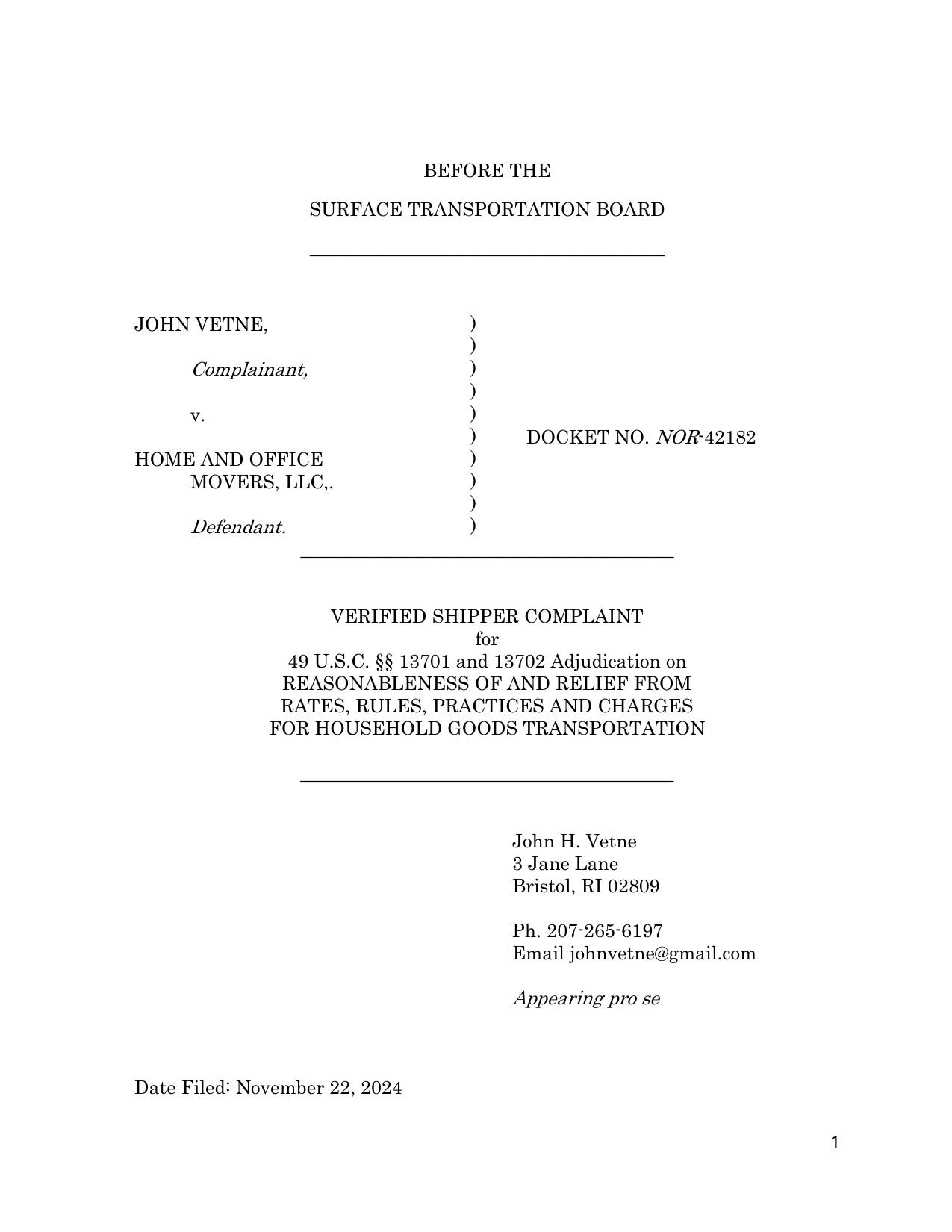
The first household goods shipper complaint filed with the Surface Transportation Board in 25 years (Docket NOR-42182, November 2024). Filed under 49 USC 13701-13702 for adjudication of rate reasonableness.
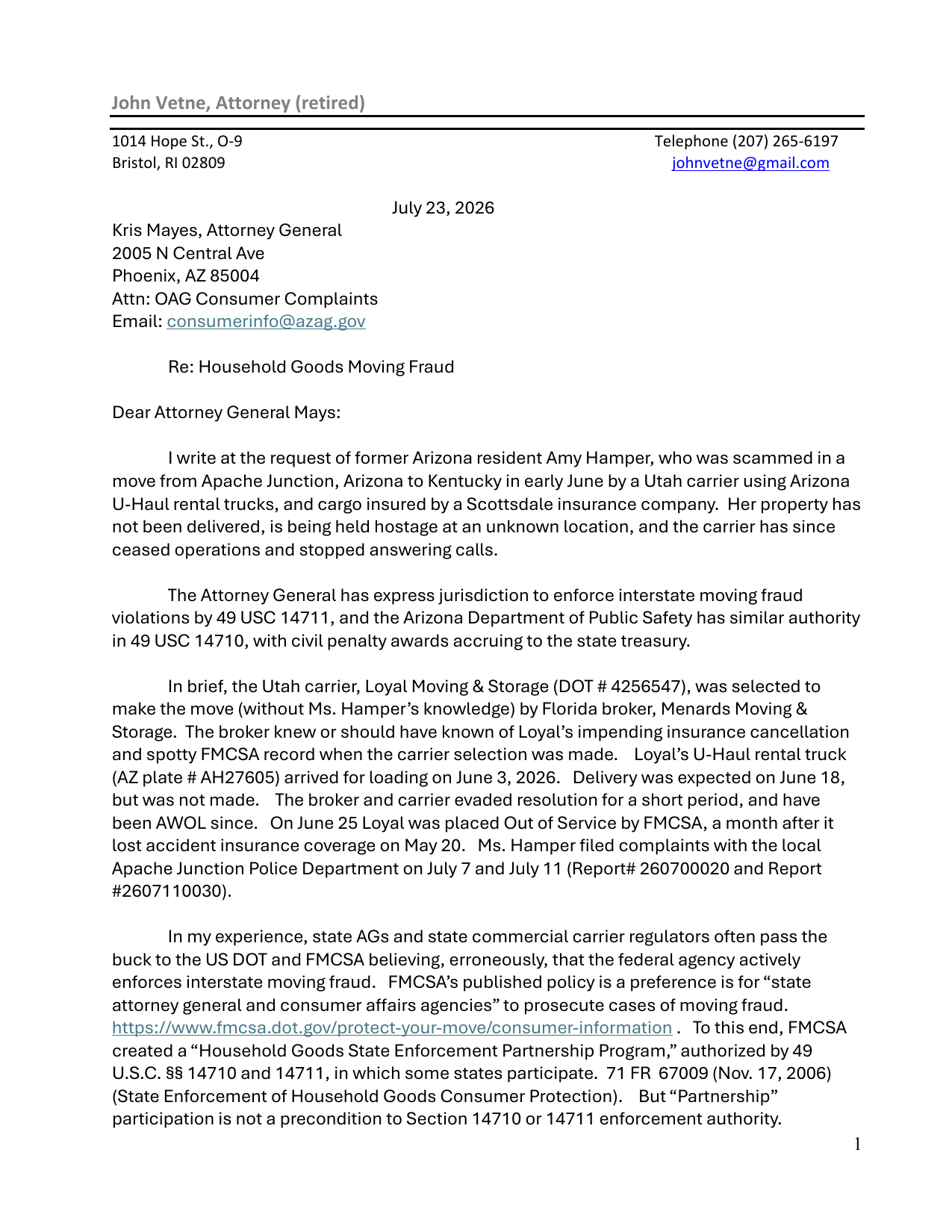
Letter to Arizona AG Consumer Protection division citing state authority under 49 USC 14710 and 14711 to enforce FMCSA household goods regulations. States can collect civil penalties and share them with consumer victims.
Data
Federal Penalties for Household Goods Moving Violations (Inflation-Adjusted)
| Violation | Statute | Penalty | Notes |
|---|---|---|---|
| Intentional tariff pricing violation | 49 USC 14903 | Up to $205,375 per violation. Up to 2 years imprisonment. | Highest HHG civil penalty. Charging more than the published tariff. |
| Unauthorized HHG brokering | 49 USC 14901(d)(3) | Not less than $25,000 per violation | Carrier brokering without broker authority. Personal liability for officers/directors. |
| Broker estimate without carrier agreement | 49 USC 14901(d)(2) | $20,486 per violation | Providing estimate without a compliant broker-carrier agreement. |
| Unauthorized broker services | 49 USC 14901(d)(3) | $51,211 minimum | Operating as broker without required registration. |
| Hostage goods | 49 USC 14915 | Not less than $16,279 per violation. 12 to 36 month license suspension. | Each day carrier fails to release goods is a separate violation. |
| Falsifying weight or volume | 49 USC 14912 | Up to 2 years imprisonment | Weight-bumping or volume inflation (fluffing). |
| False Bill of Lading with intent to defraud | 49 USC 80116 | Up to 5 years imprisonment | Criminal penalty for fraudulent shipping documents. |
| General unauthorized brokering | 49 USC 14916(c) | Up to $10,000 per violation | Plus liability to injured party for ALL claims without cap. |
| Operating without authority (HHG) | 49 USC 14901(d)(3) | Not less than $37,400 per violation | Carrier or broker operating without required FMCSA registration. |
Source: 49 USC Subtitle IV, Part B. Inflation adjustments per FMCSA Civil Penalty Amounts, 88 Fed. Reg. 1114 (Jan. 6, 2023). Consumer OIG complaint appendix penalty table.
Companies Mentioned
Contributors: John H. Vetne
Sources: FMCSA complaint system (nccdb.fmcsa.dot.gov). Surface Transportation Board, Section 14704 of the Interstate Commerce Act. State attorney general consumer protection divisions. Trunk mover database (4,200+ carriers tracked). Expert interviews with legal professionals specializing in moving fraud.