Moving Company Complaints Spiked 111% in 2021. Five Years Later, Enforcement Hasn't Caught Up.
FMCSA NCCDB data shows a post-pandemic complaint surge followed by decline, but the enforcement gap persists.
FMCSA's National Consumer Complaint Database (NCCDB) recorded 9,128 moving company complaints in 2021, more than double the pre-pandemic baseline. Complaints have since declined to 4,481 in 2025, but remain above 2019 levels. Hostage loads, overcharging, and price disputes remain the dominant complaint types. FMCSA does not publish a breakdown by category, so Trunk built one: we scraped complaint records for every registered mover from FMCSA's Protect Your Move database and aggregated them nationally. The results are available at trunk.lorea.ai/dashboard/nccdb.
The enforcement response has been minimal. Broker enforcement cases in FY 2025 and FY 2026: zero. The tools Congress created to combat hostage loads exist in statute but go unused.
The Numbers
FMCSA's NCCDB tracks consumer complaints against moving companies. The data tells a clear story: a massive post-pandemic spike followed by gradual decline.
Moving company complaints by year: 2021: 9,128 | 2022: 6,846 | 2023: 4,402 | 2024: 3,663 | 2025: 4,481 | 2026 (partial): 1,311.
The 2021 spike coincided with a historic surge in household moves during the pandemic relocation wave. As moving volume normalized, complaints declined, but remain above pre-pandemic levels.
Important caveat: FMCSA expanded the NCCDB beyond household goods to include other motor carrier complaints. Some historical figures cited in media (including the often-quoted "8,825 complaints in 2022") may include non-HHG complaints. The figures above reflect the "Moving Company" category specifically, per FMCSA's published NCCDB statistics.
FMCSA launched "Operation Protect Your Move" in 2023, conducting investigations across 16 states and uncovering 1,014 regulatory violations, and repeated the operation in 2024 across 17 states. The agency cited complaint increases as the catalyst, but the timing suggests external pressure played a larger role: a 2020 BBB study ("Know Your Mover") documented price gouging and hostage loads at scale, Newsweek published investigations in 2016 and 2023, and consumer advocacy organizations including MovingScam.com and USMPO had been documenting patterns for years.
BBB reported 5,918 consumer complaints against moving companies in 2023. Reported scams likely represent only 5% to 10% of actual incidents, based on crime reporting research.
The Category Question
FMCSA does not publish a breakdown of NCCDB complaints by category. Trunk built one by scraping complaint records for every registered interstate mover from FMCSA's Protect Your Move database and aggregating them by category, state, company type, and year (trunk.lorea.ai/dashboard/nccdb).
Early results from Georgia, Maryland, Virginia, Florida, and California show Estimates/Final Charges as the #1 complaint category, followed by Pickup and Delivery, Shipment Documents, and Consumer Complaint (Deceptive Business Practices). Hostage Goods ranks in the middle of the 14 categories, not at the top as previously reported. The Southern FMCSA region (which includes Florida and Georgia) accounts for the overwhelming majority of complaints.
The category ranking matters for enforcement prioritization, but the structural problem remains the same: regardless of which category leads, FMCSA lacks effective tools to address any of these complaint types in real time.
Why Hostage Loads Are Different
A damaged item is an accident. A late delivery is a logistics failure. A hostage load is extortion.
The carrier has leverage that no other service industry possesses: physical custody of everything you own. Once your belongings are on the truck, you have no recourse other than paying or waiting for enforcement action that may take weeks.
The pattern is consistent across complaints: the customer receives a low initial quote, the movers load the truck, then mid-move or at delivery they demand significantly more money, typically via Zelle or cash (no chargeback protection). The customer pays because the alternative is losing their belongings.
FMCSA can revoke operating authority, but that takes weeks to months. State law enforcement can investigate, but moving fraud cases are rarely prioritized. The consumer is left alone with no rapid remedy.
A DOT OIG report from 2013 documented a case that illustrates the human cost. An elderly couple relocating from Colorado to Nevada because of the wife's poor health hired a company online. The estimate was $1,340. After loading, the cost became $7,400, a more than 500% increase. The wife's wheelchair was among the goods held hostage. The carrier told the couple: 'You are not getting it, period.' Investigators later found the carrier's owner was using the victim's computer and television in his business.
The Financial Stress Connection
The complaint spike correlates directly with industry financial pressure. In 2023, only 40% of moving companies met revenue goals. A third took emergency financing. Rising interest rates pushed moving activity to its lowest level in over 30 years. By mid-2026, diesel prices surged back above $5.13 per gallon nationally, squeezing margins further for carriers already struggling with declining spot rates.
When revenue drops, some carriers cut crew wages, defer maintenance, and look for ways to extract more from each job. The hostage-load playbook (quote low, demand more at delivery) is a rational if criminal response to margin pressure.
The fraud pressure is not limited to consumers. Carriers themselves are victims of broker fraud. Owner-operator Ruben Dotto, profiled in Overdrive Magazine in July 2026, described a deal where a broker's failure to pay left him hauling a $3,800 partial load for little more than fuel money. His solution: insist on cash before unload, or decline the load entirely. When carriers can't trust brokers and consumers can't trust carriers, the entire chain of trust in household goods transportation has broken down.
24% of moving companies planned to expand their service offerings in 2024. The pressure that drives operational drift is the same pressure that drives hostage loads. Both are symptoms of an industry that cannot support its current number of operators at current demand levels.
Methodology
Complaint data sourced from FMCSA NCCDB published statistics (Moving Company category). Financial health data from SmartMoving 2024 and 2025 State of the Moving Industry Reports. Insurance premium data from Elromco Spring 2024 Regulatory Update.
This article was updated July 2026 to correct complaint figures using FMCSA's published NCCDB data. Earlier versions cited higher totals that may have included non-HHG complaint categories. Category breakdown percentages (previously cited as 31% hostage, 24% damaged goods, etc.) have been removed as they cannot be independently verified from public FMCSA data.
The Legal Remedy Most Consumers Don't Know About
Section 14704 of the Interstate Commerce Act contains an adjudicatory procedure at DOT's Office of Hearings for household goods disputes, including hostage loads and overcharges. The problem: FMCSA has never written rules to implement it. A legal professional specializing in moving fraud cases had to invent the filing process himself after being scammed by a carrier that brought a truck too small for the cubic footage they charged. He recovered $9,500, the full overcharge, but the process took hundreds of hours and required administrative adjudication complaints both to DOT's Office of Hearings, and the Surface Transportation Board. The fact that this remedy exists but has no formal rules means almost no consumers know about it, and almost no lawyers practice it. The NCCDB (National Consumer Complaint Database), the FMCSA repository for complaints by consumers and truckers, has been described by carrier industry professionals as the place 'where complaints go to die.'
The Riojas Decision: How FMCSA Lost Its Enforcement Tool
In 2019, an FMCSA administrative law judge ruled in the Riojas case (Docket No. FMCSA-2012-0174) that FMCSA does not have administrative civil penalty authority for household goods violations. This decision effectively ended FMCSA's ability to financially penalize movers for fraud, overcharging, and hostage loads. Before Riojas, FMCSA could initiate civil penalty cases against the worst offenders. After Riojas, its enforcement options were reduced to warning letters, notices of violation, and license revocation, tools it rarely uses. The 2023 Operation Protect Your Move initiative, which FMCSA promoted as a major crackdown, targeted only 142 movers across 17 states. Of those, 93 were investigated and 44 were inspected. Two license suspensions resulted, both for safety violations, not financial fraud. No specific referrals to the Department of Justice for civil or criminal prosecution were mentioned in the final report.
The Hostage Load Remedy Congress Created (That FMCSA Abandoned)
In 2005, Congress created penalties for hostage loads in the SAFETEA-LU legislation. Section 49 USC 14915 imposes civil penalties of not less than $10,000 per violation (now $15,445 inflation-adjusted) for carriers that hold household goods hostage, plus suspension of the carrier's or broker's registration for 12 to 36 months. Criminal penalties including imprisonment are also authorized. In 2012, Congress added a further remedy in the MAP-21 legislation: 49 USC 14915(a)(1) now provides that 'The Secretary may order, after notice and an opportunity for a proceeding, that a person found holding a household goods shipment hostage return the goods to an aggrieved shipper.' FMCSA wrote implementation procedures in 2006 and a compensation policy in 2015 that allowed Field Administrators to suspend operating authority and force carriers to compensate victims through settlement agreements. After the 2019 Riojas decision stripped FMCSA of civil penalty authority, the agency cancelled its compensation policy. The tools Congress created still exist in the statute, but FMCSA has not created any process by which a consumer can invoke or request the agency to apply the remedy. A legal professional working on hostage load cases created his own request form on behalf of a victim whose belongings were held for five months. FMCSA provided no effective response. The victim eventually recovered her belongings, but only after sustained pressure outside the agency process.
The Binding Estimate Fee: Another Tool for Overcharging
All household goods shipments must be preceded by a good faith cost estimate (49 USC 14104(b)(1)(A)). A separate fee can be charged for a binding estimate. No regulation limits this fee. In one documented case, the binding estimate fee was $4,600, representing 60% of total broker charges and 32% of the carrier's final bill. A reasonable binding estimate fee should not exceed 10% of the estimate, corresponding to the maximum shipper benefit of avoiding up to 10% additional charges on delivery under the 110% rule for non-binding estimates (49 USC 13707(b)(3)(A)). In the absence of industry self-restraint on fees for binding estimates, FMCSA should amend its consumer protection rules to provide a clear nexus between the fee and the binding vs. non-binding benefit to consumers.
Moving Company Complaints Spiked Then Declined
Annual FMCSA NCCDB complaints (Moving Company category)
Source: FMCSA NCCDB Published Statistics
The Financial Pressure Behind the Spike
40%
Movers meeting revenue goals (2023)
33%
Took emergency financing
+14%
Cargo insurance premium increase
1,014
FMCSA violations found (2023)
17
States investigated
24%
Planning to expand services
drift signal
Source: SmartMoving 2024; Elromco 2024
Evidence
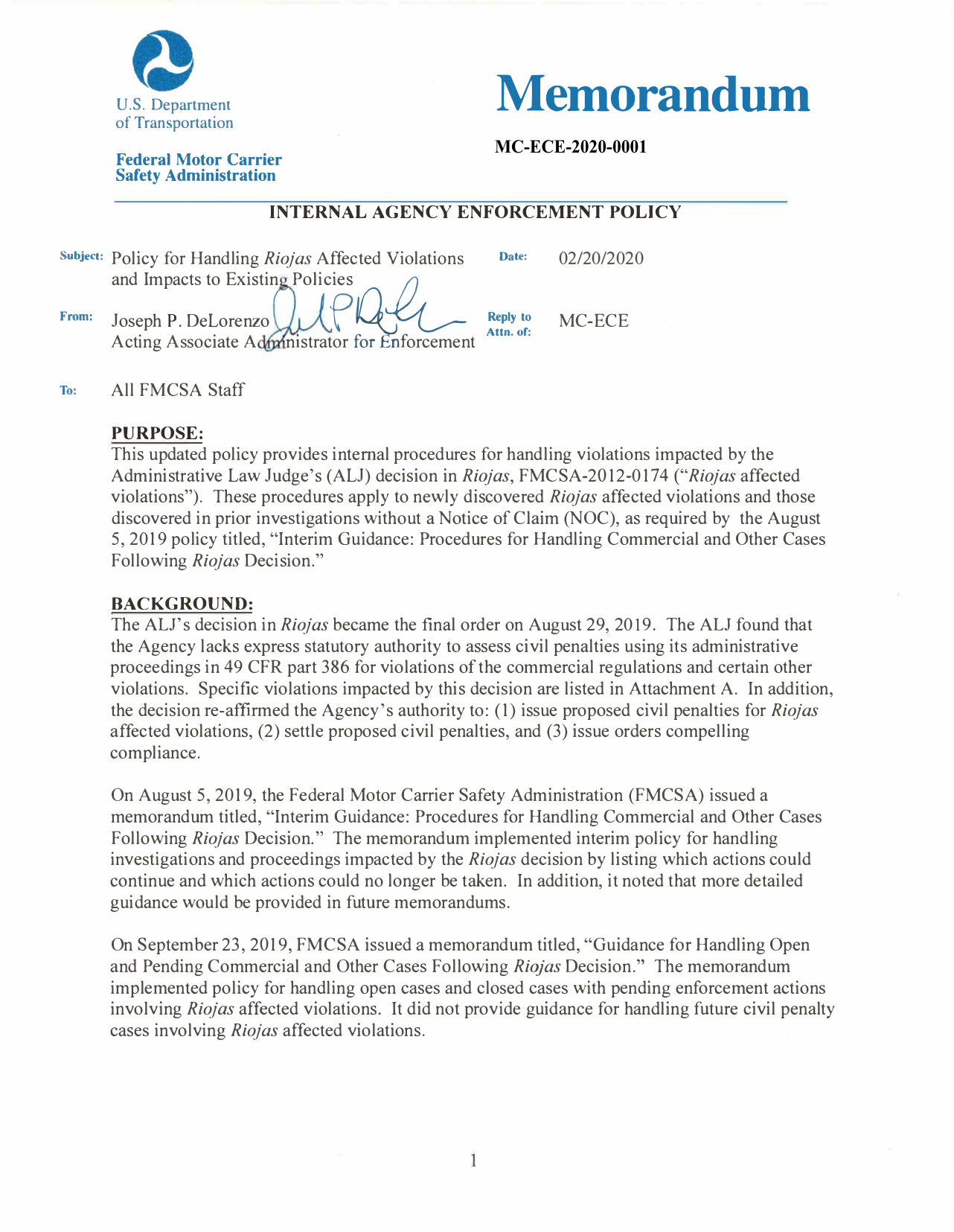
FMCSA's own internal enforcement policy (February 2020) acknowledging the agency 'lacks express statutory authority to assess civil penalties' for household goods violations after the Riojas decision.
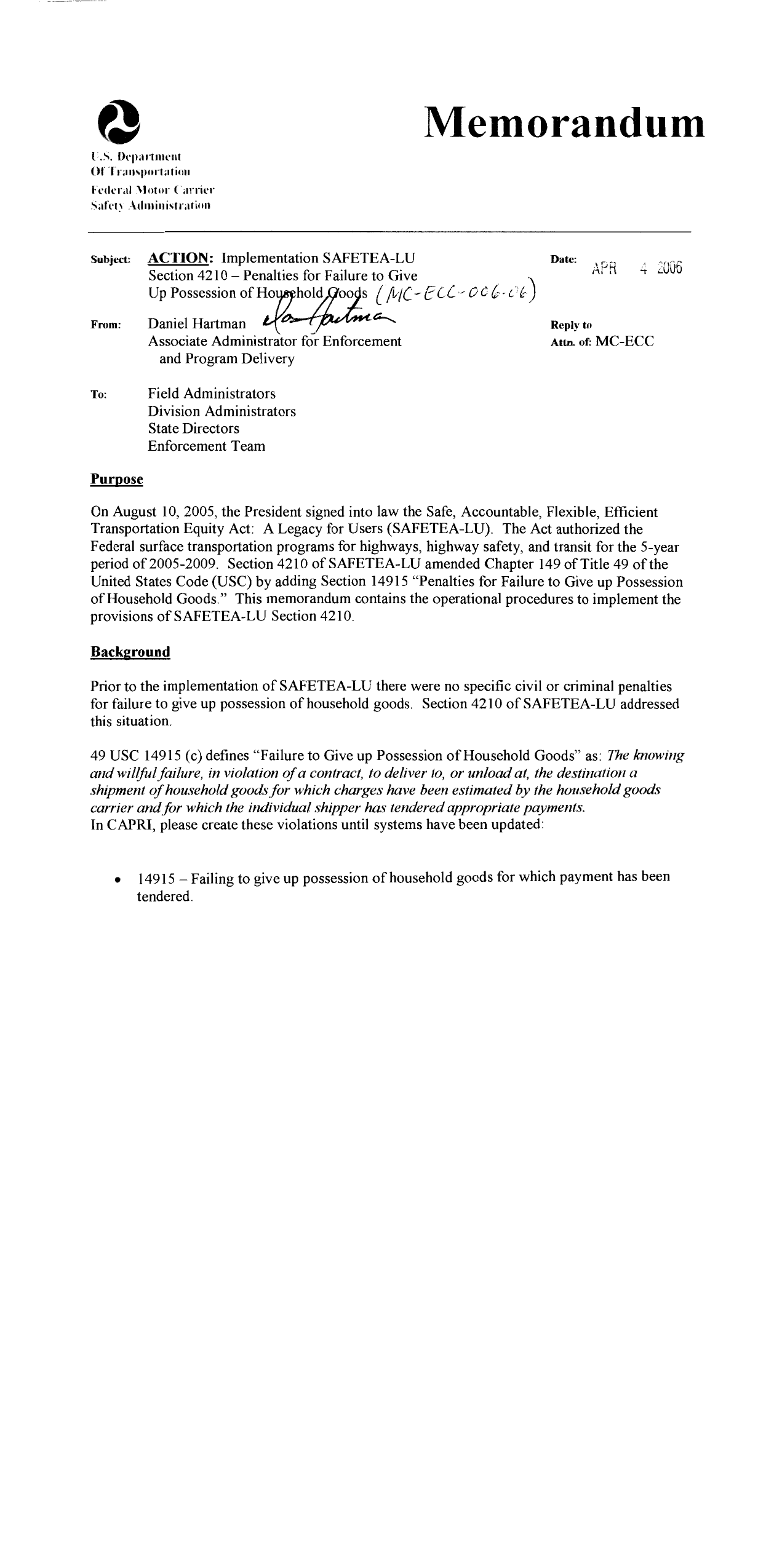
FMCSA's 2006 implementation memo for congressional hostage load penalties: $10,000+ per violation and 12-36 month license suspension. These tools exist on paper but are rarely used.
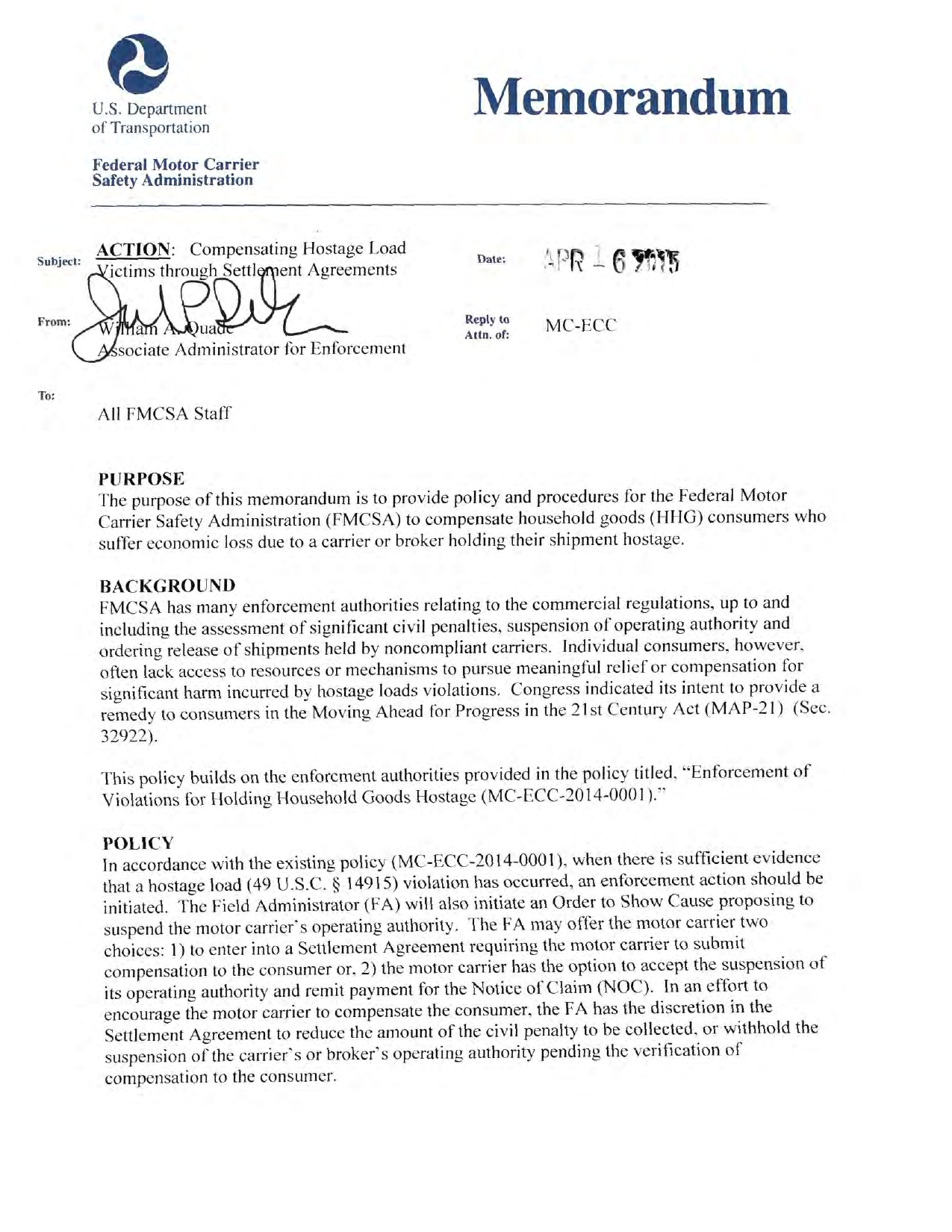
FMCSA's 2015 policy for compensating hostage load victims through settlement agreements. This policy was cancelled after the 2019 Riojas decision.
Data
FMCSA NCCDB Moving Company Complaints: 2021 to 2026
| Year | Moving Company Complaints | Notes |
|---|---|---|
| 2021 | 9,128 | Post-pandemic spike (+111% vs pre-COVID) |
| 2022 | 6,846 | Decline begins |
| 2023 | 4,402 | Operation Protect Your Move launched |
| 2024 | 3,663 | Lowest since pre-pandemic |
| 2025 | 4,481 | Slight rebound |
| 2026 | 1,311 | Partial year (through ~March) |
Source: FMCSA NCCDB Published Statistics (Moving Company category)
Contributors: John H. Vetne
Sources: FMCSA NCCDB Published Statistics (Moving Company category); FMCSA Operation Protect Your Move 2023 and 2024 reports; SmartMoving 2024 and 2025 State of the Moving Industry Reports; Elromco Spring 2024 Regulatory Update. Updated July 2026 with verified FMCSA complaint figures.