One Lawyer vs. an Industry: How a Retired Attorney Is Forcing FMCSA to Act
A retired lawyer got scammed by a mover, then spent hundreds of hours studying moving law and the industry, and in the process uncovered a legal remedy the Department of Transportation neglected to implement.
The Origin Story
In October 2023, a retired lawyer moved from West Virginia to Rhode Island. The broker was Eagle Moving Group, a Florida company now doing business as New Start Relocation. The carrier was Home & Office Movers, based in Maryland. The first estimate was $4,727. The final charge on moving day was $14,299, more than triple the quote. The smoking gun: the volume-based charge by the carrier was for more cubic feet than the moving truck could physically hold.
The lawyer spent the next two years studying household goods transportation law. In November 2024, he filed a complaint with the Surface Transportation Board asking for reparations for tariff violations. It was the first HHG shipper complaint filed with the STB in 25 years. The carrier hired San Diego transportation attorney Michael Garcia. The case settled within weeks with $9,500 recovered.
In March 2025, he filed the first-ever Section 14704(c)(1) complaint to the Secretary of Transportation against the broker. In 30 years since Congress created this remedy, no HHG consumer had invoked it. After months of what he described as 'apparent head-scratching and angst by the DOT/FMCSA bureaucracy,' the complaint was referred to the Office of Hearings and assigned to an administrative law judge.
He has since represented multiple fraud victims pro bono, filed formal enforcement requests with FMCSA and the DOT Inspector General, and developed the regulatory reform agenda that legitimate industry participants have begun to endorse.
The Discovery: Section 14704
Section 14704 of the amended Motor Carrier Act (49 U.S.C.), created by the 1995 ICC Termination Act, provides an adjudicatory procedure before the Secretary of Transportation for consumers, carriers and others injured by carrier or broker regulatory violations. The law authorizes consumers to file a complaint with the Secretary (or state and federal courts), to recover damages resulting from regulatory violations, and elect to pursue the claim through administrative adjudication rather than civil court. The statute of limitations is four years, and attorney fees are recoverable. The Surface Transportation Board has a parallel process for household goods tariff (service menu) disputes. The Federal Maritime Commission has a parallel procedure for consumer remedies involving international shipments of household goods. But FMCSA, the agency responsible for implementing Section 14704 for household goods disputes, never wrote rules of procedure. No forms exist. No filing instructions exist. No agency staff are assigned to process these claims. The lawyer had to invent the filing process himself, adapting procedures from the Federal Maritime Commission's small claims process (46 CFR Part 502) and proposing a draft 'instituting order' for the DOT Office of Hearings.
The First Case: Eagle Moving Group
The lawyer filed a Section 14704 complaint against Eagle Moving Group, Inc. (d/b/a 'New Start Relocation'), a household goods broker, before the Secretary of Transportation in March 2025. His 22-page memorandum laid out the complete regulatory history of household goods consumer protection, from the Interstate Commerce Commission's creation in 1887 through the ICC Termination Act of 1995 to the present. The memorandum documented the frequency of moving fraud (8,825 FMCSA complaints in 2022, 636% increase in hostage complaints since 2019), the cost to consumers ($350 to $430 median per scam), and the systematic failure of FMCSA enforcement. He settled the carrier's share of the overcharges through a Surface Transportation Board complaint under 49 USC 13701-13702 (STB Docket NOR-42182) in November 2024, recovering $6,500. The complaint was based on the carrier's tariff violations and unreasonable rates, not the broader 14704 regulatory violation framework. This was the first household goods shipper complaint filed with the STB in 25 years. The Maryland carrier hired a San Diego transportation attorney to respond, and the case settled within weeks with good carrier cooperation. The STB remedy for tariff disputes is another consumer option that FMCSA completely ignores in its 'protect your move' website. The complaint against the broker before the Secretary of Transportation was finally referred to DOT's Office of Hearings in January 2026, and settled in March by payment of $3,000.
The Second Case: A Broker, a Carrier, and a Hostage Load
In June 2026, the lawyer filed a complaint on behalf of a consumer whose move from North Carolina to New Orleans was brokered by Menards Moving and Storage (USDOT 4072455, Greenacres, Florida). The broker gave a 'binding estimate' of $4,895 for 813 cubic feet. On moving day, Handle With Care Moving (USDOT 3190967, Tucker, Georgia) arrived instead, a carrier the consumer had never heard of, whose FMCSA license had been revoked twice before and was revoked again on March 30, 2026. Handle With Care was subsequently reincarnated as JCS Moving and Storage, with the help of Menards, and continued to operate without missing a beat. The carrier billed $7,264 for 1,400 cubic feet. When the consumer would not pay the inflated balance, the carrier threatened to keep the household goods in storage for 30 days and then auction them. The consumer ultimately paid $2,000 in additional charges under duress to secure delivery. Upon delivery, many items were missing or damaged. The consumer documented $38,942 in property loss at full replacement value. The carrier's claims adjuster offered $92, contingent on signing an NDA and waiving the right to discuss the experience publicly. The broker's owner demanded negative Facebook posts be removed as a precondition for assisting with claims. The DOT/FMCSA has not yet, more than a month after submission to the agency, referred the complaint to the Office of Hearings for assignment to an Administrative Law Judge. When the retired lawyer filed the Section 14704 complaint on behalf of the consumer, the broker's compliance department responded with a cease and desist letter challenging his standing to appear as a representative, rather than addressing the underlying damages claim. The lawyer cited 49 CFR 386.4, which provides that 'a party may appear in person, by counsel, or by other representative, as the party elects' in FMCSA proceedings. The broker's response to a documented $44,966 consumer claim was to attack the representative's credentials.
The Third Front: Requesting Criminal Investigation
On May 1, 2026, the lawyer wrote to the DOT Office of Inspector General requesting criminal investigation of Noble Moving and Storage (NJ), owned by Joseph Hannouch, and Moving Logistic Inc (CA), on behalf of a consumer whose binding estimate of $6,166 became a final cost of $19,472 (316% of the estimate). Noble brokered the move without broker authority. Moving Logistic charged for 2,200 cubic feet on a truck with a maximum capacity of 1,800. Delivery was forwarded to a third carrier that demanded $1,500 in undisclosed fees before unloading. The letter documented volume overstatement, mileage inflation of 17.6%, and violations across 15 federal statutes including RICO conspiracy. A separate request was sent to FMCSA Administrator Derek Barrs and eight named officials on May 28, 2026, requesting expedited suspension or revocation of Howards Vanlines (USDOT 4391903, New Jersey), whose corporate principals are Karim Hassan and Ahmad Riyad Alomari, and whose undisclosed principals appear to include Joseph Hannouch and his wife, Farah Al-Ibrahim. The request cited nine statutory violations and documented that Howards' first HHG application had been dismissed by FMCSA on May 19, 2025, before being approved four months later. The company had stolen the identity of a legitimate carrier, Howard's Van Lines of Dayton, Ohio (DOT 1245219), and accumulated 89 NCCDB complaints in eight months of operation from a single registered truck. Bait-and-switch examples included a $3,968 estimate inflated to $11,881 and a $4,000 estimate inflated to $17,089. FMCSA did not acknowledge receipt. The attorney escalated to the DOT Office of Inspector General the following day. In a related matter, the lawyer filed a hostage goods request under 49 USC 14915(a)(1) on behalf of a moving scam victim, asking FMCSA to order the carrier to return her household goods being held hostage, and to suspend the carrier's operating authority. FMCSA provided no effective response. The consumer eventually recovered her belongings after five months in the carrier's storage, and is now documenting damage and missing items.
What the Cases Reveal About the System
Across these cases, a consistent pattern emerges. Brokers collect deposits and provide lowball estimates without physical surveys. They assign moves to carriers with histories of license revocations, complaints, and enforcement actions, or to newly-authorized carriers with no reliable history. Carriers inflate cubic footage or weight on moving day, demand payment before delivery, and offer minimal compensation for damage. Claims adjusters condition settlements on NDAs and speech waivers. FMCSA's complaint database (NCCDB) logs complaints but generates no consequences. The Office of Inspector General has never audited FMCSA's household goods enforcement unit. The 2019 Riojas decision stripped the agency of civil penalty authority. FMCSA's authority to suspend or revoke HHG authority of carriers and brokers was unaffected by Riojas, yet rarely (if ever) exercised. FMCSA's responsibility to vet carriers' and brokers' competence and ethics for special HHG authority, as required by 2012 legislation, is still waiting agency implementation. And the Section 14704 administrative remedy, which Congress explicitly authorized in 1995, sits unused because FMCSA never wrote the rules to implement it. The American Trucking Association's Moving Conference was presented with this information in February 2026 and did not acknowledge or respond, suggesting the industry has a vested interest in keeping consumer remedies difficult to access. FMCSA's own enforcement data confirms this: national closed carrier enforcement cases dropped 65% from FY 2024 to FY 2025. Broker enforcement cases went to zero. Of 7,020 carrier investigations in 2025, only 167 involved household goods carriers, despite over 3,200 consumer complaints.
The Proposals
The lawyer's Section 14704 administrative complaints suggest amendment of household goods regulations and promulgation of formal procedures for Section 14704 adjudication. His proposed 'instituting order' template, adapted from Federal Maritime Commission small claims procedures used for international household goods moves, would allow consumers to file verified complaints with the DOT Office of Hearings, have them assigned to an Administrative Law Judge, and receive adjudication based on submitted documents without requiring oral testimony in most cases. If adopted, this would create the first accessible, low-cost federal administrative remedy for moving fraud victims. The retired lawyer continues to help consumers by pro bono review of moving fraud situations, remedy suggestions, paralegal research and drafting, and victim representation in administrative claims for which 'any person' may appear for another.
Why This Matters for Consumers
The gap between what the law allows and what the agency enforces is where most moving fraud thrives. Section 14704 gives consumers the right to recover damages through an administrative process that is supposed to be faster and cheaper than court. But until FMCSA writes the rules, consumers are left with NCCDB complaints that generate no enforcement, civil lawsuits that cost more than the damages, and an agency whose message, as stated in its own Rights and Responsibilities handbook, is essentially: you are on your own. Independent verification platforms like Trunk exist because the regulatory system designed to protect consumers is not functioning. Every mover profiled on Trunk is checked against eleven independent sources because no single source, including the federal regulator, provides a complete picture.
Evidence
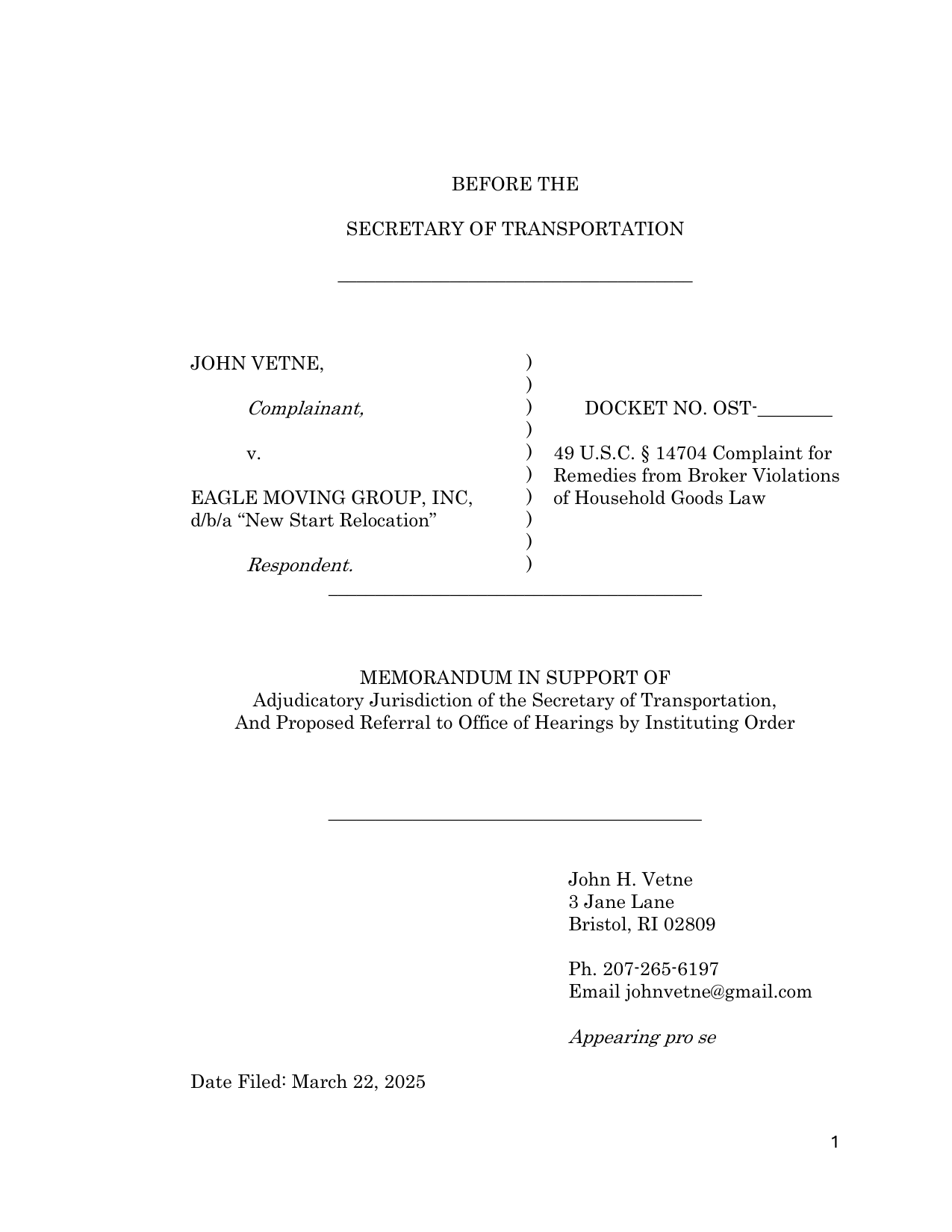
The first known Section 14704 administrative complaint filed before the Secretary of Transportation for household goods broker violations. Filed March 2025.
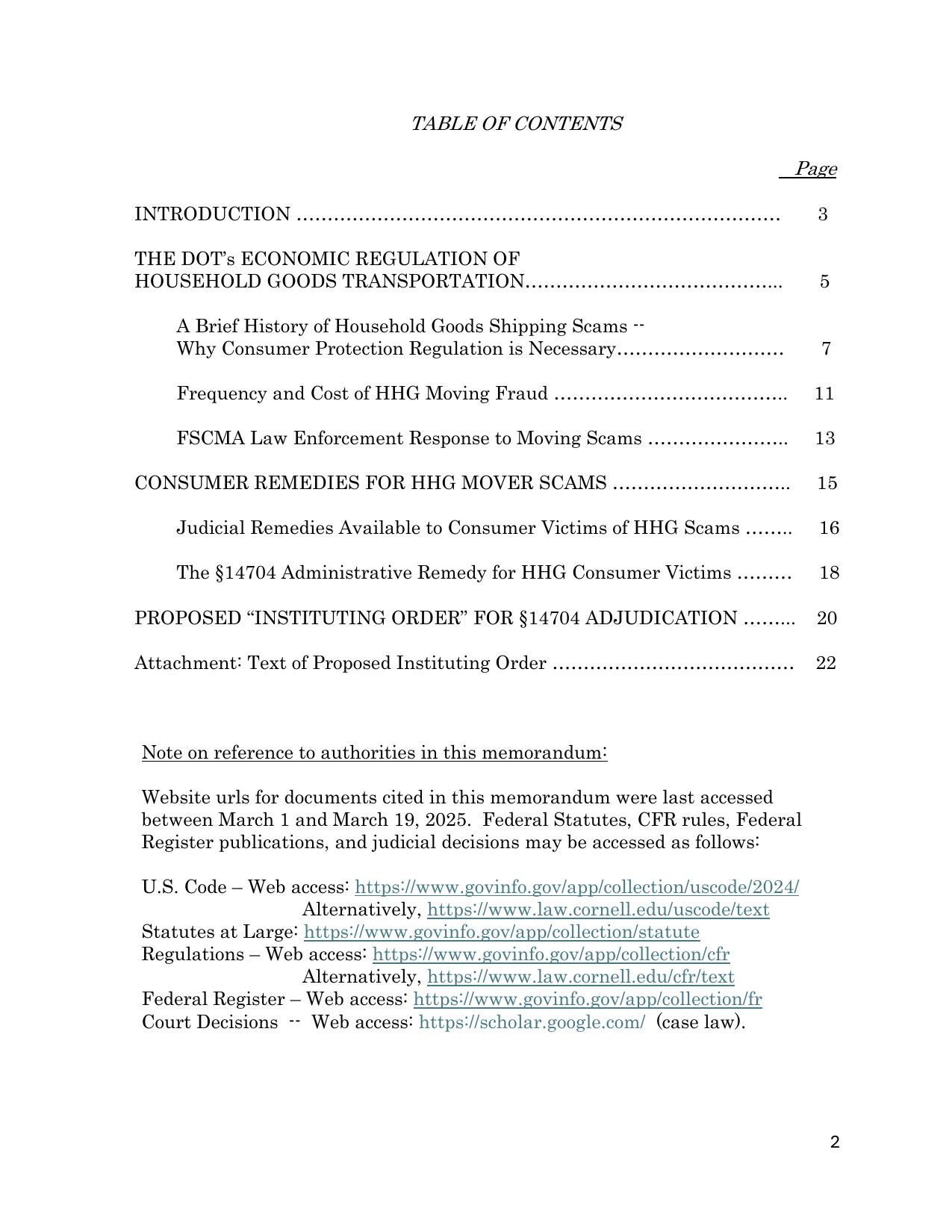
Table of contents of the 22-page memorandum documenting the regulatory history of household goods consumer protection and the Section 14704 remedy.
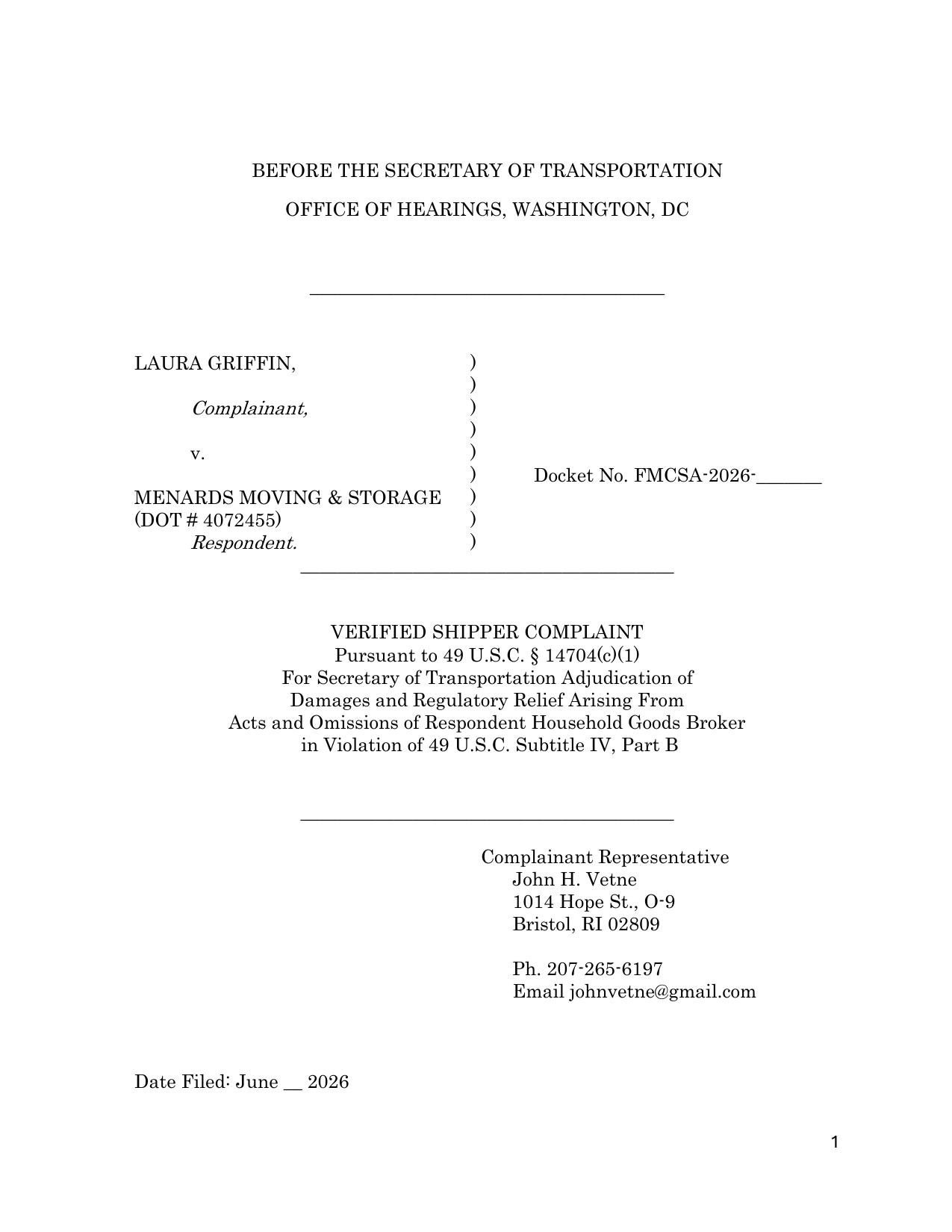
A second Section 14704 complaint filed June 2026, on behalf of a consumer whose move was brokered to a carrier with three FMCSA license revocations.
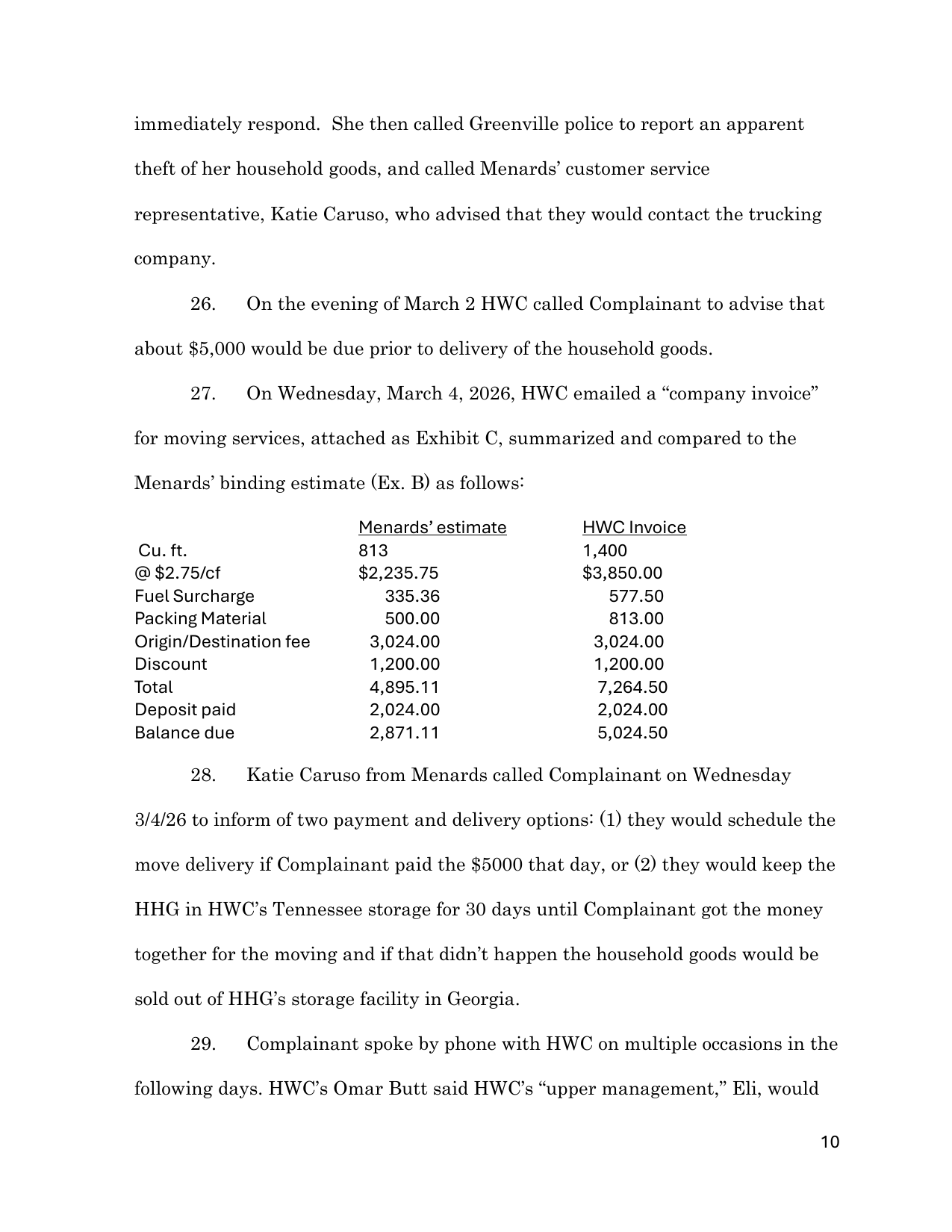
The broker's binding estimate of $4,895 for 813 cubic feet vs. the carrier's invoice of $7,264 for 1,400 cubic feet. A 48% increase in price driven by a 72% increase in claimed volume.
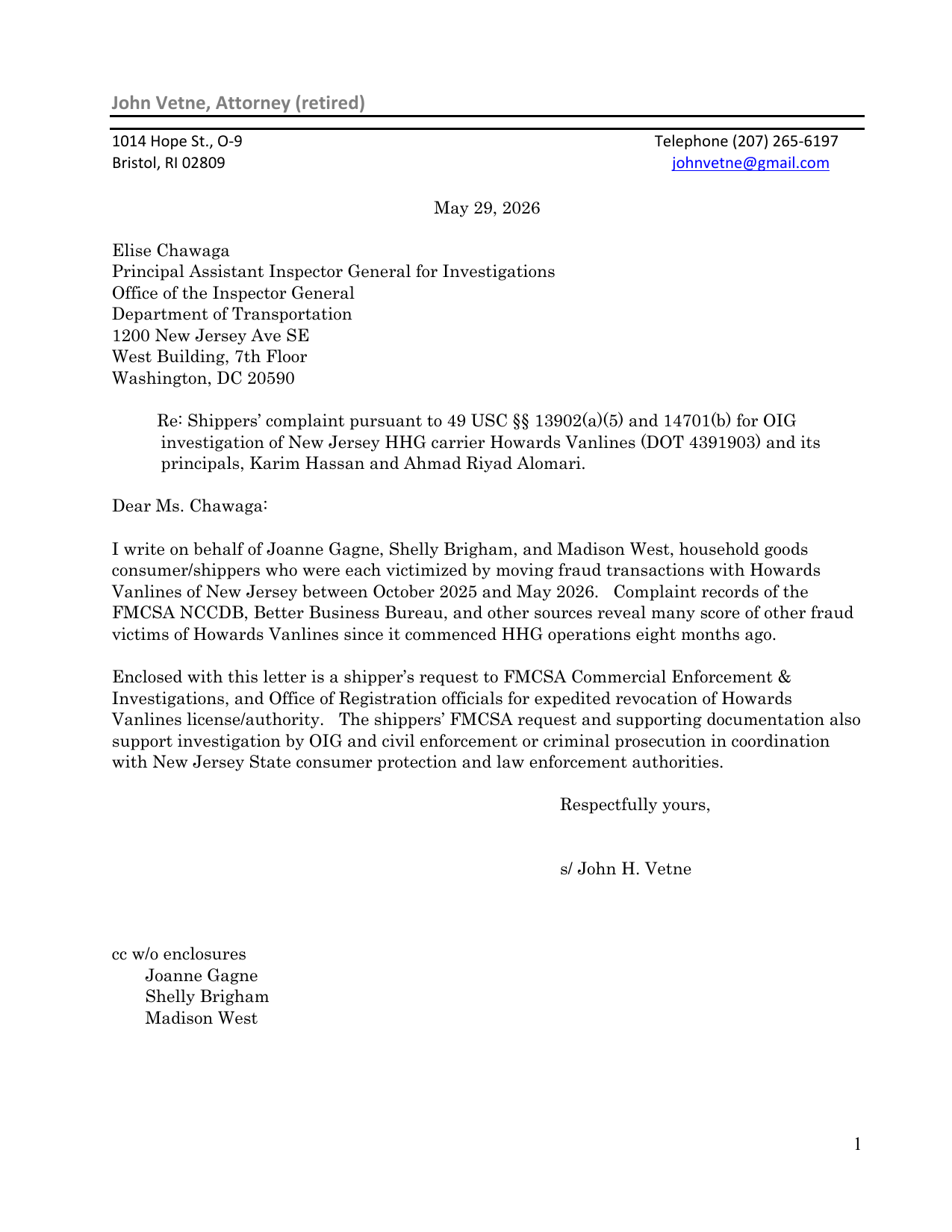
Letter to the DOT Office of Inspector General requesting investigation of Howards Vanlines for fraud affecting three consumers between October 2025 and May 2026.
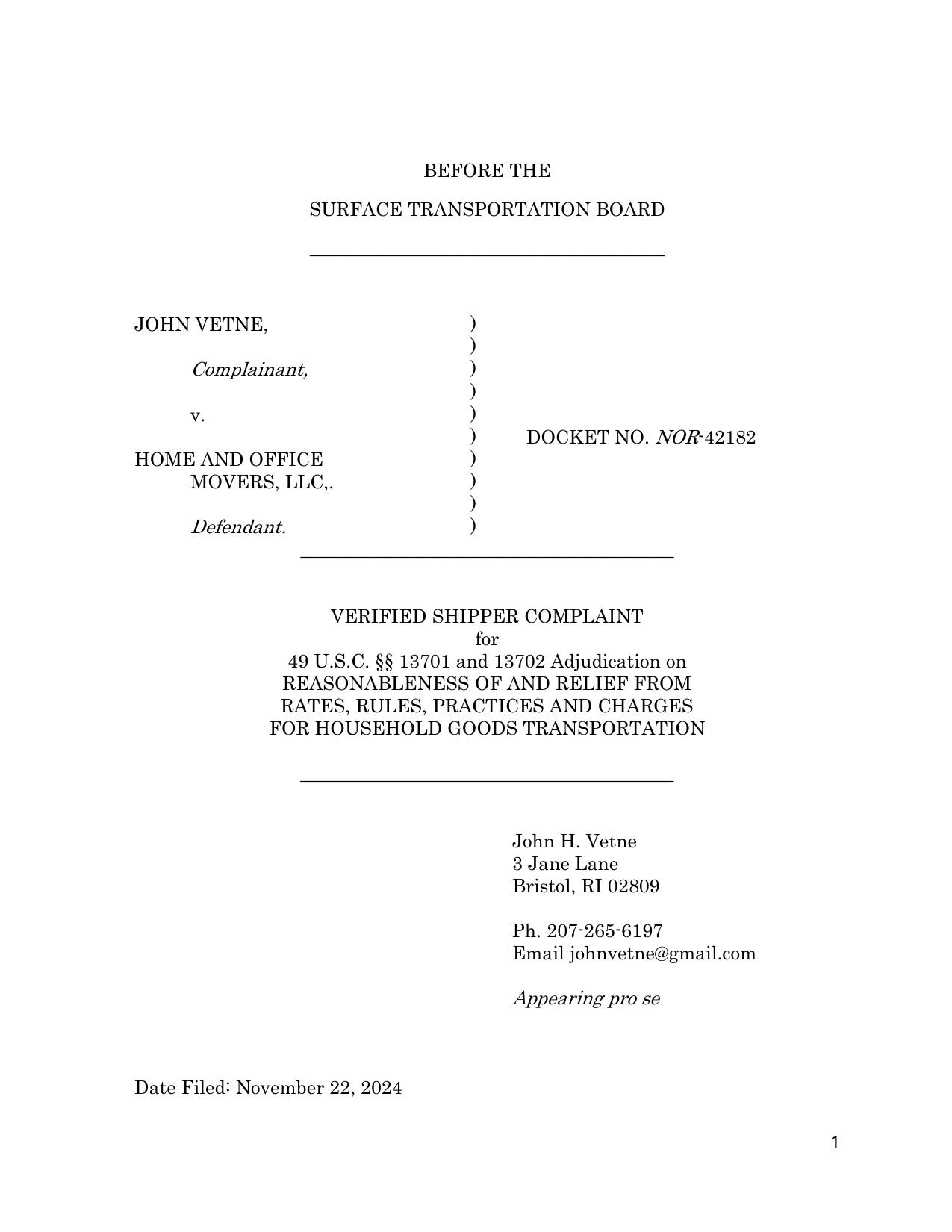
Verified Shipper Complaint filed with the Surface Transportation Board under 49 USC 13701-13702 for adjudication of rate reasonableness. The first HHG complaint to the STB in 25 years.
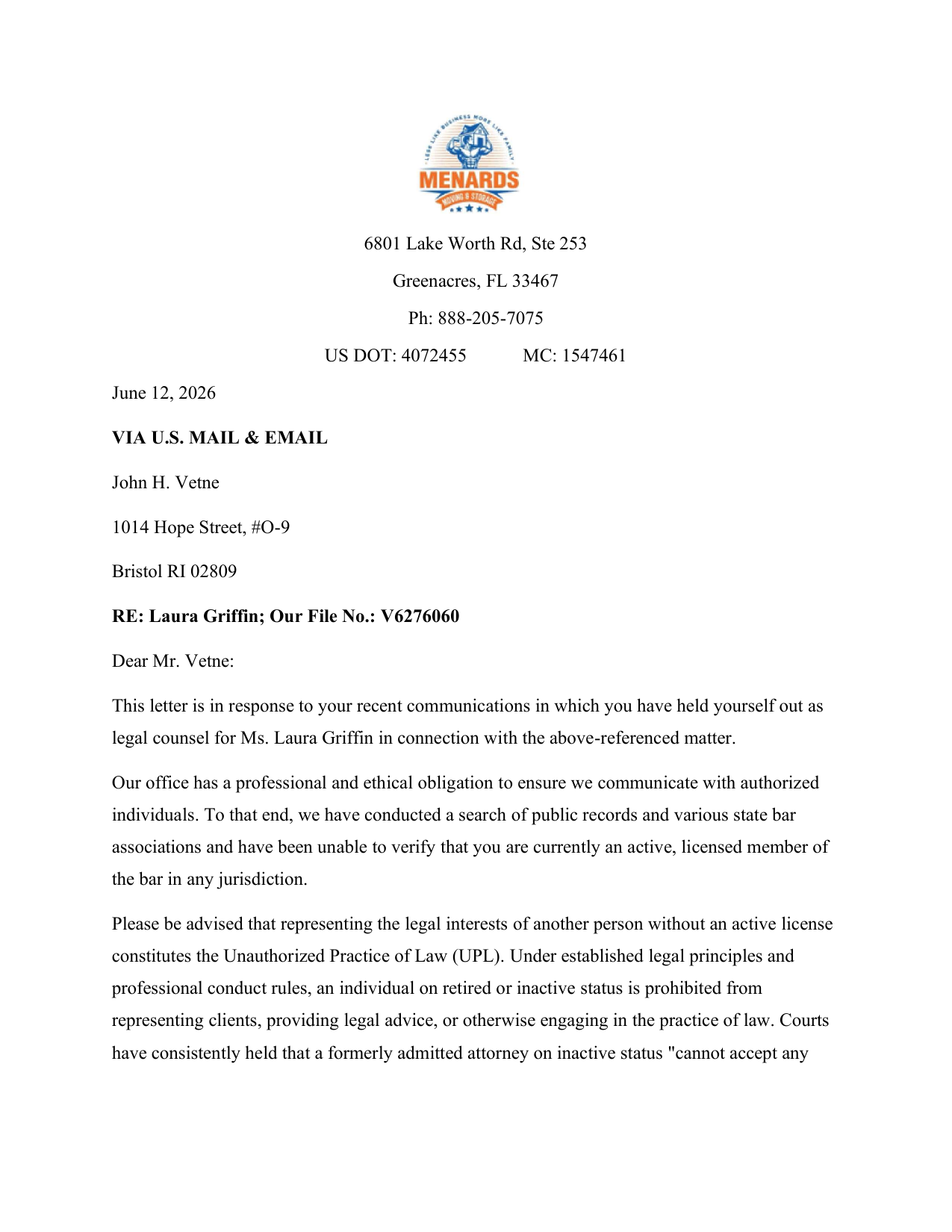
When the retired lawyer filed a Section 14704 complaint on behalf of a consumer, the broker responded with a cease and desist challenging his standing rather than addressing the $44,966 damages claim.
Companies Mentioned
Contributors: John H. Vetne
Sources: Legal filings shared with permission. FMCSA SAFER database, Surface Transportation Board records, FMCSA NCCDB complaint data, GAO reports (GAO-01-318, GAO-10-38, GAO-23-105972), FMCSA Operation Protect Your Move Final Report (2023), BBB Scam Tracker Risk Report (2023), DOJ press releases (ED NY 2024, ED Pa 2022), homemovingnow.com.