H.R. 880: The Household Goods Shipping Consumer Protection Act, Explained
A pending bill that would restore FMCSA's enforcement authority, expand state enforcement powers, and begin addressing two decades of regulatory failure.
What the Bill Does
H.R. 880, the Household Goods Shipping Consumer Protection Act, was introduced by Representatives Eleanor Holmes Norton and Mike Ezell. The bill addresses two core problems. Section 2 would restore FMCSA's authority to assess civil penalties for household goods violations, reversing the 2019 Riojas decision that stripped the agency of this enforcement tool. Before Riojas, FMCSA could impose financial penalties on carriers and brokers for consumer fraud. After Riojas, the agency's enforcement options were reduced to warning letters and license revocation, tools it rarely uses. Section 4 would expand state enforcement of federal HHG shipping consumer protection rules under 49 USC 14710-14711, allowing state attorneys general to retain fines and penalties assessed against brokers and carriers for violations of HHG regulations.
Why It Matters
The Riojas decision created an enforcement vacuum that persists today. National closed carrier enforcement cases dropped from 3,794 in FY 2024 to 1,312 in FY 2025, a 65% decline. Broker enforcement went to zero in FY 2025 and remains at zero. Without civil penalty authority, FMCSA has no financial deterrent against fraud. Carriers and brokers can overcharge consumers, hold goods hostage, and operate under false pretenses with no risk of monetary sanctions from the federal regulator. Restoring this authority would not solve the problem alone, but it would give the agency a tool it currently lacks entirely.
What the Bill Does Not Address
H.R. 880 is a beginning, not a comprehensive solution. The bill does not address NCCDB transparency (consumers cannot research complaint histories against movers). It does not require carrier tariffs to be published online (water carriers and international shippers must publish tariffs online for free, but HHG carriers do not). It does not increase the inadequate $5,000 carrier insurance minimum for household goods inventory. It does not address volume fraud (no regulatory controls exist for cubic footage measurements, unlike weight-based shipments which have federal verification rules). It does not fix the 180-day billing dispute deadline that FMCSA never mentions on its website. And it does not address the arbitration neutrality problem, where carriers select 'mover-friendly' arbitration providers. It does not cap binding estimate fees, which are unregulated and have been documented as high as $4,600 on a single move (60% of total broker charges), functioning as a hidden overcharge rather than a reasonable fee for price certainty. A reasonable binding estimate fee should not exceed 10% of the estimate, corresponding to the maximum shipper benefit of avoiding up to 10% additional charges under the 110% rule for non-binding estimates.
These gaps are not new discoveries. GAO reports in 2001 and 2009 documented that FMCSA's household goods enforcement was 'haphazard, ineffective, and of low priority in an agency whose primary focus is truck safety.' A 2023 GAO report found the agency still 'tracks enforcement actions through a separate system and does not identify if a complaint led to an enforcement action.' Twenty-five years of GAO recommendations have produced no structural change. These issues require either amendments to the bill, separate legislation, or FMCSA rulemaking.
The State Enforcement Problem
Section 4's expansion of state enforcement authority is welcome but contains a structural flaw. Current law under 49 USC 14711(b)(4) imposes up to a 60-day delay for notice to the federal agency before a state attorney general can file an enforcement action, while 14710 allows a state agency to file an action with simultaneous notice to the federal agency. The 60-day delay should be deleted or reduced to 7 days. Sixty days is too long to wait when carriers and brokers routinely dissolve and reincorporate to evade enforcement. By the time a state AG can act, the entity may no longer exist. The bill should also identify participating state agencies and contacts, which FMCSA's website currently does not do despite eleven states having agreed to participate in the Household Goods State Enforcement Partnership Program.
Current Status
H.R. 880 is pending in the House of Representatives. A parallel Senate bill, S. 337, is co-sponsored by Senator Deb Fischer and addresses similar enforcement authority issues. The bill has bipartisan support (Norton is a Democrat, Ezell is a Republican).
This is not a new effort. The bill was first introduced in the 118th Congress as H.R. 8505, where it gained mostly Republican bipartisan support. It was reintroduced in the current Congress as H.R. 880. Two years, two Congresses, no traction in either chamber. The Senate Transportation Committee held a hearing on moving fraud in February 2025 ('Grand Theft Cargo'), the first congressional attention to the issue since the 2012 hearings that examined Aldo DiSorbo and Colonial Van Lines, but the hearing produced no legislative action.
In the same period, Congress introduced the SAFE Act targeting chameleon carriers, passed legislation criminalizing staged truck crashes, and held multiple hearings on trucking safety. Moving fraud, which victimizes individual consumers who move once every few years and have no organized lobby, has produced no equivalent urgency. The bill's bipartisan support has not translated into committee action or floor scheduling in either session.
Consumers can support the bill by contacting their congressional representatives and referencing the documented enforcement failures, complaint statistics, and consumer harm data compiled by Trunk, USMPO, and other independent platforms.
Evidence
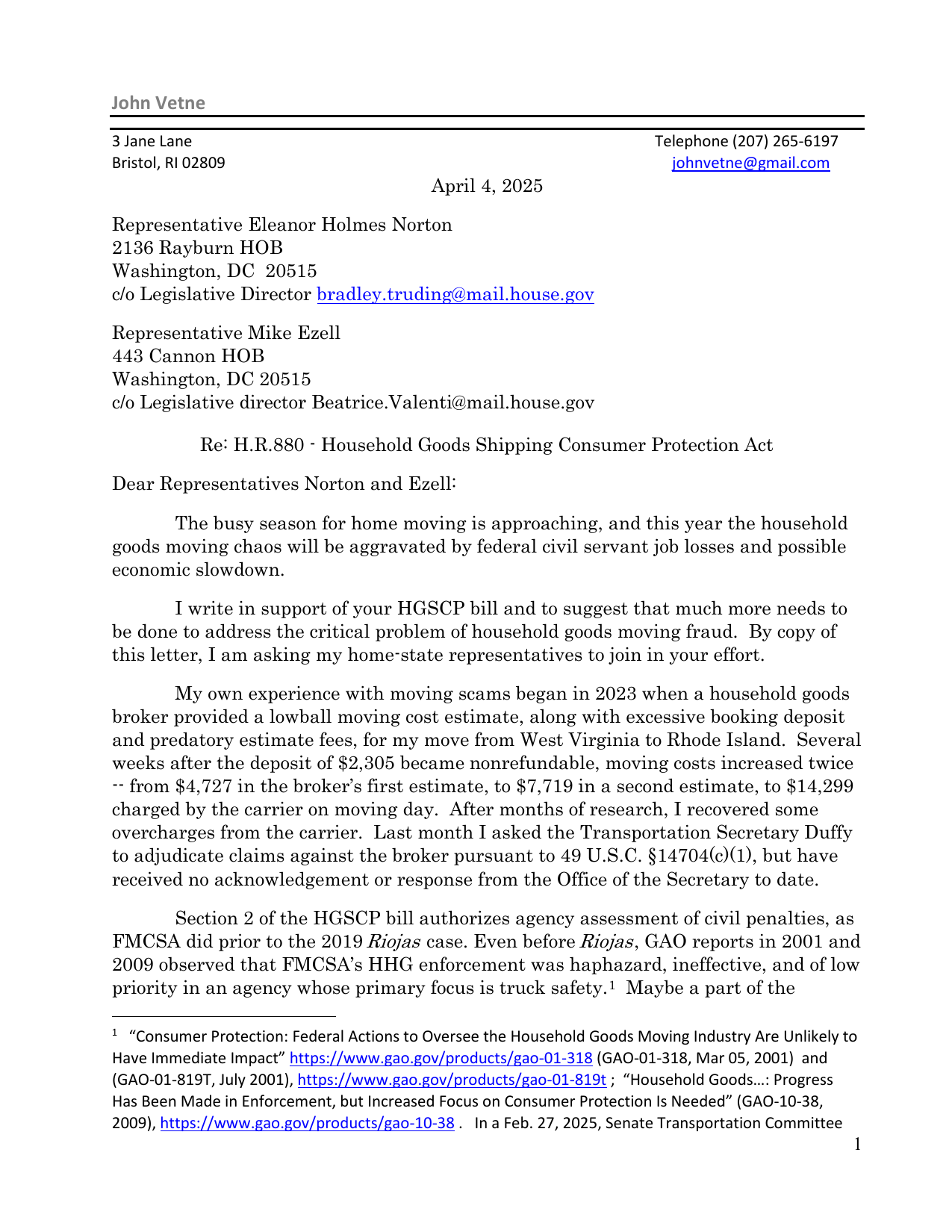
Letter to House sponsors of H.R. 880 proposing additional reforms including NCCDB transparency, tariff availability, insurance adequacy, billing dispute deadlines, and volume fraud controls.
Companies Mentioned
Contributors: John H. Vetne
Sources: H.R. 880 bill text. Letter supporting H.R. 880 (April 2025). GAO reports GAO-01-318 (2001), GAO-10-38 (2009), GAO-23-105972 (2023). Senate Transportation Committee hearing 'Grand Theft Cargo' (February 2025). FMCSA enforcement data.