FMCSA Has a Safety System. It Has Nothing for Fraud.
The agency responsible for protecting consumers from moving fraud has never built the tools to do it.
Two Systems, One Blind Spot
FMCSA operates the Safety Measurement System (SMS) to score carriers on safety violations, crash history, and inspection results. It works. Dangerous trucking companies get flagged and eventually shut down. But for household goods fraud, including overcharging, hostage loads, bait-and-switch pricing, and stolen goods, there is no equivalent system. No fraud score. No pattern detection. No automated enforcement triggers.
The SMS proves that FMCSA can build effective monitoring infrastructure. The absence of anything comparable for consumer fraud is a policy choice, not a technical limitation.
Where Complaints Go to Die
Consumer complaints about moving fraud go to FMCSA's complaint intake division. According to practitioners who have worked with the agency, FMCSA's complaint intake process logs complaints but rarely initiates enforcement. Lewie Pugh, Executive Vice President of OFMCSA's complaint intake process (Owner-Operator Independent Drivers Association), described it in February 2025 Senate Transportation Committee testimony as the place "where complaints go to die." The complaints create a paper trail but generate no consequences for the carrier.
This matters because consumers are told to file FMCSA complaints as their primary remedy. The agency's own website directs victims of moving fraud to the complaint hotline. But filing a complaint with an office that does not act on complaints is not a remedy. It is a placebo. Consumers who file complaints against brokers sometimes have them denied on jurisdictional grounds. One consumer who reported Choice Vanlines, a broker with multiple theft and damage complaints, had their FMCSA complaint rejected. The complaint was valid. The system rejected it because the consumer filed under the wrong company classification. When the complaint mechanism itself is a barrier, the enforcement gap compounds.
The Enforcement Catch-22: States Say Federal, Feds Say State
FMCSA's Protect Your Move website and publications tell consumers that 'primary responsibility for HHG moving fraud enforcement lies outside of the Department of Transportation,' directing them to state authorities. When consumers contact state authorities, they are told that interstate moves are federal jurisdiction.
In a documented 2026 case, a Howards Vanlines victim contacted the Georgia Attorney General's office. The AG's staff told her that once items cross state lines, she must file with federal authorities. She was advised to 'make noise,' contact local TV stations, and file with the attorney general in the state where the moving company is registered. The Georgia AG's office was helpful but clear: this is not their jurisdiction.
The same pattern plays out in Florida, where most of the highest-complaint brokers are registered. In July 2026, a consumer who contacted the Florida Governor's office about Florida-based moving fraud received a reply directing them to FMCSA: 'The U.S. Department of Transportation's Federal Motor Carrier Safety Administration licenses interstate moving companies. You should continue working with their office to reach a resolution.' The Governor's office noted that the Florida Department of Agriculture and Consumer Services regulates intrastate movers only. For interstate fraud originating from Florida, the state says: go to FMCSA.
Georgia says go to the feds. Florida says go to the feds. FMCSA says go to the states. The consumer is bounced between jurisdictions while the carrier continues operating. This is not an isolated experience. Consumer advocacy groups and Facebook fraud awareness pages document the same runaround repeatedly. Federal law (49 USC 14710 and 14711) explicitly authorizes state attorneys general to enforce FMCSA household goods regulations. This authority was granted by Congress in the SAFETEA-LU Act of 2005. Four years later, a 2009 Government Accountability Office survey found that no state attorney general or state regulatory agency had ever used this grant of authority to bring a case against an interstate mover (GAO-10-38). The reasons states gave: federal remedies do not benefit the states, penalties are insufficient, and they cannot bring cases in state court.
In one documented Broward County case (CONO-23-002897, April 2023), a pro se consumer filed against Home and Office Movers and United Best Moving LLC, citing FDUTPA and the Florida Household Moving Services Act. The complaint was modeled on FL AG enforcement filings but was brought by an individual consumer, not the Attorney General's office. The case was removed to federal court and ultimately dismissed, with the carrier awarded $9,665 in attorney fees against the consumer. The authority Congress granted in 2005 remains effectively unused by state attorneys general in 21 years.
Even when state AGs do engage, enforcement can fail. In a 2023 case, the Kentucky Attorney General's Office of Consumer and Senior Protection actively mediated between a consumer and a carrier network that was holding household goods hostage. The KY AG investigator asked the carriers for documents, asked where the planned auction of the consumer's belongings would take place, and attempted to negotiate. The carriers simply stopped responding. The last documented communication was August 15, 2023. The consumer's belongings, including the only photos of her deceased son, were auctioned without notice. The state AG had the jurisdiction and the will. The carriers had the goods and the indifference.
The exception proves the rule. When a retired attorney filed a moving fraud complaint with the Arizona Department of Public Safety on behalf of a consumer, a dedicated HHG enforcement trooper responded within a week with specific investigative questions: had the carrier demanded payment beyond the contract, what did the delivery window say, had the rental truck been returned, were GPS trackers placed with the shipment. Arizona has a Household Moving Complaint Line (602-223-5000) and troopers assigned to HHG enforcement. The trooper could not investigate the carrier directly because it was based in Utah, but offered to assist in recovering the consumer's belongings if they were still in Arizona. This is what state-level enforcement looks like when a state resources it. Most states do not. Between 2006 and 2014, total FMCSA fines against all carriers nationwide ranged from $17 million to $36 million per year. The largest single fine against a moving company was $281,100 in 2010. Average individual fines ranged from $30,000 to $75,000. For companies generating millions in coerced overpayments, these penalties are a cost of doing business.
The OIG Has Never Looked
FMCSA's Office of Inspector General has never audited the agency's household goods enforcement practices. FOIA requests have confirmed no systematic review exists. The agency has been pressured on safety enforcement by Congress and advocacy groups, but household goods fraud has received virtually no oversight attention.
A FOIA response (OIG-FOIA-25-0095) listing all 203 DOT OIG investigations closed in 2023 and 2024 reveals the allocation: approximately 7 involved household goods moving companies. That is 3.4% of OIG's investigative caseload. The rest were aviation, railroad, pipeline, highway safety, maritime, and DOT internal matters. Of those 7 HHG cases, at least 2 involved chameleon carrier reincarnation (one resulting in the Billingslea conviction, the other with details redacted), and one was classified as 'Operation Bust a Mover.' Some took over three years to close.
FMCSA's complaint database received 4,484 HHG complaints in 2025 alone. The OIG closed approximately 7 HHG investigations in two years. The ratio of consumer complaints to completed investigations is roughly 1,300 to 1.
The most recent OIG Semiannual Report to Congress (October 2025 through March 2026) lists zero FMCSA audit reports issued during the period. The audit that has never been conducted, a systematic review of FMCSA's household goods enforcement practices, remains unconducted. HHG is not listed as a separate investigative priority area in the report.
For context, OIG's first dedicated HHG enforcement initiative, Operation Boxed Up (2013), opened 12+ investigations and made 7 arrests when FMCSA was receiving approximately 2,200 complaints per year. Complaint volume has since doubled to 4,484 per year. The enforcement response has not scaled with the problem.
Section 14704: The Consumer Remedy Nobody Implements
Section 14704 of the amended Motor Carrier Act provides an adjudicatory remedy for consumers damaged by regulatory violations and moving fraud at DOT's Office of Hearings and the federal Surface Transportation Board for many household goods disputes. The Secretary of Transportation (DOT) is responsible for writing rules of practice implementing this procedure for Office of Hearings cases. In 31 years since Congress created this remedy, DOT has failed to do so. The statute provides real authority: DOT's Office of Hearings, or the Surface Transportation Board (depending on the nature of the claim), can find regulatory violations and order payment of refunds and other damages to consumers. An Office of Hearings finding, in turn, creates a record that would support an FMCSA enforcement remedy or HHG license suspension for the carrier or broker. Attorney fees will be assessed if federal court intervention is required for collection of the consumer remedy. But without implementing regulations, filing procedures, and other consumer guidance by FMCSA, the law functions as a theoretical protection that requires extraordinary legal knowledge to invoke.
The claim that DOT's Office of Hearings cannot handle motor carrier cases is incorrect. Federal docket records show at least four DOT Office of Hearings enforcement proceedings against motor carriers between 2009 and 2019: Phoenix Moving and Storage Inc. of Brooklyn (FMCSA-2009-0116, hearing in New York), Tom Ort Trucking Inc. (FMCSA-2007-0006, hearing in Madison WI), A Adams Trucking & Adams Air Freight Inc. (FMCSA-2008-0403, hearing in Boston MA), and Spencer Bros. LLC (FMCSA-2016-0386, New Hampshire). All were assigned to ALJs in DOT's Office of Hearings with full procedural orders: discovery deadlines, witness exchange, pre-hearing conferences, and scheduled hearings. FMCSA's own trial attorneys from the Office of Chief Counsel represented the agency as claimant in each case. The infrastructure to adjudicate cases exists. It has been used at least four times in the last 15 years. The question is why it is not being used for HHG consumer protection.
The gap is not structural. It is a choice. The Federal Maritime Commission, which handles international household goods moves, has a functioning small claims process under similar statutory authority. In Gruenberg-Reisner v. Overseas Moving Specialists (FMC Docket 1947(I), 2016), consumers quoted $17,575 for an international move were billed $40,264. They filed a small claim with the FMC's Small Claims Officer. No lawyer was required. The proceeding was document-based, no oral testimony needed. The SCO found the mover violated Section 41102(c) and awarded $17,847 in reparations. The full Commission affirmed. The same type of consumer, the same type of dispute, the same type of harm, resolved through an accessible federal process. For domestic interstate moves, Congress created equivalent adjudicatory authority under Section 14704. FMCSA has had 31 years to write the implementing rules. It has not done so.
When a retired attorney filed the first Section 14704 shipper complaint with the DOT Office of Hearings in March 2025, FMCSA's own Acting Deputy Chief Counsel called him personally. In a May 2025 email, the counsel wrote that he wanted the agency to 'issue some type of response to the Complaint by June 30, 2025.' He then left the agency two weeks later. The Chief Counsel was cc'd. Whether a response was issued is not publicly known. The person who understood the complaint and wanted to act on it left the building. The institutional knowledge walked out the door with him.
A replacement was eventually assigned: a Senior Attorney Advisor in FMCSA's Denver regional office. In a July 2025 exchange, the complainant raised a separate issue: a FOIA request filed 11 months earlier for public documents (carrier/broker license applications that require no review) had not been processed. The complainant called FMCSA's FOIA delay a 'hostile obstruction to shipper remedies,' noting that the 180-day deadline for overcharge claims (49 USC 13710(a)(3)(B)) can expire while FMCSA sits on a FOIA request for records needed to prosecute that claim.
The 2026 DOT Chief FOIA Officer Report (March 2026, covering FY 2025) explains why. FMCSA received 9,647 FOIA requests in FY 2025, more than any other DOT component, including the FAA (6,080). Meanwhile, DOT's full-time FOIA staff was cut 10% (from 65 to 58). The FOIA backlog across DOT grew 40%, from 8,048 requests at the end of FY 2024 to 11,250 at the end of FY 2025. FMCSA's own report claims FOIA is 'part of its core mission' and that it has 'improved its technology for more efficient processing.' The backlog tells a different story. FY 2026 quarterly data shows the problem accelerating: FMCSA received 8,625 FOIA requests in the first three quarters alone (on pace for 11,500 for the full year), but processed only 6,674. The FMCSA FOIA backlog stood at 6,256 requests at the end of Q3, larger than the total FOIA requests received by every other DOT component combined.
Howards Vanlines: A Complete Enforcement Request, Ignored
On April 24, 2026, a retired transportation attorney emailed FMCSA's Commercial Enforcement and Investigations division asking whether the agency had an active investigation into Noble Moving and Storage and offering to contribute. No response. On May 1, he filed a formal OIG investigation request for Noble on behalf of a consumer whose binding estimate of $6,166 became $19,472. No response. On May 28, he sent a formal enforcement request to FMCSA Administrator Derek Barrs and eight named officials, requesting expedited suspension or revocation of Howards Vanlines' carrier authority (DOT 4391903). The letter cited nine specific statutory violations including hostage goods, unauthorized brokering, bait-and-switch pricing ($3,968 estimate to $11,881 in one case; $4,000 to $17,089 in another), and wire fraud. It was filed on behalf of three named victims with supporting documentation.
FMCSA's own published description of its application vetting process states that the agency evaluates 'the nature and extent of existing or past violations,' 'whether existing or past regulatory or statutory violations are the result of a willful failure to comply,' and 'the existence and nature of pending and closed enforcement actions.' Applicants are required to disclose 'any relationships involving common stock, common ownership, common management, common control or familial relationships with any FMCSA-regulated entities.'
Despite this vetting framework, Howards' first HHG application was dismissed by FMCSA on May 19, 2025, four months before a second application was granted on September 26, 2025. The company then stole the identity and reputation of a legitimate carrier, Howard's Van Lines of Dayton, Ohio (DOT 1245219), falsely claiming '60+ years of moving expertise' while operating a single box truck licensed for eight months. At the time of the letter, Howards had accumulated 89 NCCDB complaints, including three hostage load complaints in four days.
FMCSA did not acknowledge receipt of the enforcement request. No response was provided. The attorney escalated the same request to the DOT Office of Inspector General the following day. Weeks later, KMBC Kansas City began airing investigative reports on the same company. The carrier continued operating.
This is a case where FMCSA received a complete, statute-cited enforcement package from an attorney with decades of transportation law experience, on behalf of named victims, with documented evidence of nine categories of violation. The agency's response was silence.
The resource allocation contrast is instructive. In late July 2026, Administrator Barrs personally participated in Operation Highway Shield, a multi-state enforcement blitz across Illinois, Indiana, Iowa, and Ohio that placed 766 drivers out of service in three days. The agency can mobilize significant field enforcement resources when directed. During the same period, the Howards enforcement request remained unanswered, zero broker enforcement cases were closed, and FMCSA had not yet published its overdue broker transparency rule. The question is not whether FMCSA has the capacity for enforcement. It is whether household goods consumer protection receives any share of that capacity.
Operation Protect Your Move: Enforcement Theater
FMCSA's highest-profile enforcement effort, Operation Protect Your Move (2023-2024), targeted 142 movers in 17 states over a period of weeks. Of those, 93 were investigated and 44 were inspected. The results: 180 consumer complaints were substantiated, enforcement action was limited to letters of probable violation, notice of claim, and notice of violation. Two license suspensions resulted, both for safety violations, not for consumer fraud. No movers involved in economic fraud or scam patterns were identified in the report, and no referrals to the Department of Justice were mentioned. The 2019 Riojas decision (FMCSA-2012-0174-0056) stripped FMCSA of administrative civil penalty authority for consumer protection violations, leaving the agency with Letters of Probable Violation (LOPVs) as its primary tool. A transportation law firm that analyzed the LOPV process found that they tell the mover it 'may' pay the proposed penalty, 'may' request a conference, and if the mover does nothing, FMCSA 'may' refer the case to DOJ. Every action word is permissive. Payment is described as not constituting 'an admission that any violation(s) occurred.' The LOPV is an enforcement tool designed to be ignored, leaving the agency with negligible financial deterrent against fraud. FMCSA can still refer cases to OIG for DOJ court-imposed civil penalties, but this path is rarely pursued. According to FMCSA's own data reported in a 2023 Newsweek investigation, the agency has worked with the Justice Department to bring only 13 criminal cases and 6 civil cases against movers since January 1, 2017. In the same period, complaints against moving companies more than doubled, from 3,030 to 7,647. Even Newsweek's finding that at least 18 companies with revoked licenses continued to advertise interstate moves prompted no visible enforcement response. FMCSA told Newsweek it would 'look at each case individually.'
Why Independent Verification Fills the Gap
When the regulator doesn't enforce, consumers need alternative sources of truth. Trunk exists because FMCSA doesn't do this job. We verify licensing, cross-reference complaints across eight sources, flag chameleon carriers, and document fraud patterns that the agency's systems are not designed to detect.
Trunk tracks over 4,200 movers. For each one, we assemble data from FMCSA records, Google reviews, Yelp, BBB complaints, Reddit threads, Facebook community groups, MovingScam.com, and expert interviews. We look for the patterns that FMCSA's complaint system does not surface: the same owner appearing under multiple company names, rental trucks replacing owned fleets, review manipulation across platforms, and complaint volumes that diverge dramatically from official ratings.
A transportation attorney who has represented moving fraud victims for years and written consumer education books about the moving industry offered a blunt assessment: consumers do not and will not do the research in advance of their move. After the fact, online research is not helpful. If consumer education alone could solve this problem, it would have worked by now.
This is not a replacement for regulation. Consumers deserve both an effective federal watchdog and independent verification platforms. The practical question is not whether consumers should research their movers, but whether the information is there when they do look. Until FMCSA builds fraud detection infrastructure comparable to what it has for safety, platforms that assemble publicly available data will remain the primary line of defense.
The Agency's Own Admission
FMCSA's internal enforcement policy memo (MC-ECE-2020-0001, dated February 20, 2020) explicitly acknowledges the impact of the Riojas decision on the agency's ability to enforce household goods regulations. The memo states that FMCSA 'lacks express statutory authority to assess civil penalties using its administrative proceedings' for Riojas-affected violations. The memo lists alternative enforcement tools including Notices of Violation, suspension of operating authority, and out-of-service orders, but notes that many of the affected violations have been 'rarely enforced in the past 6 years.' The policy cancels the agency's 2015 procedure for compensating hostage load victims through settlement agreements. It supersedes or modifies at least eight previous enforcement policies dating back to 2012, including 'Procedures for Investigating Potential Reincarnated/Chameleon and Affiliated Motor Carriers' (2012) and 'Enforcement of Violations for Holding Household Goods Hostage' (2014). The document is a roadmap of an enforcement apparatus that was dismantled piece by piece.
The pattern extends to Congress itself. In 2015, the FAST Act required FMCSA to establish a Household Goods Consumer Protection Working Group (Section 5503). The group, 15 consumer affairs experts, educators, and industry representatives, met three times at DOT headquarters and submitted 19 recommendations in September 2017. FMCSA published its response to Congress in September 2019. For most recommendations, the agency wrote: 'FMCSA is evaluating the working group's recommendation. If deemed appropriate by the Administrator/Secretary, FMCSA will develop proposed regulatory changes for notice and comment rulemaking.' The Working Group was terminated in 2018. Seven years later, virtually none of its 19 recommendations have been implemented. In 2012, Congress required proficiency examinations for HHG applicants. Fourteen years later, the exam does not exist. A private attorney published a study guide for the exam in 2015, anticipating its implementation. It is available on Amazon for $89.99. The test it prepares for has never been administered.
The Numbers: Enforcement in Free Fall
FMCSA's own data tells the story. National closed carrier enforcement cases dropped from 3,794 in FY 2024 to 1,367 in FY 2025, a 64% decline in a single year. Through July 31 of FY 2026 (10 months into the fiscal year), only 750 carrier cases had closed, an 80% decline from FY 2024 levels. Total closed cases across all categories: FY 2024, 3,949 cases ($27.8M in penalties); FY 2025, 1,367 cases ($9.8M); FY 2026 through 7/31, 771 cases ($5.5M). Broker enforcement is even starker: 13 total closed cases nationally across seven fiscal years (FY 2020 through FY 2026), totaling $116,634 in penalties. Zero broker cases have closed since FY 2024. Across all regions, FY 2025 enforcement ran at 27% to 39% of FY 2024 levels. State-level data confirms the collapse is universal. See FMCSA Closed 13 Broker Cases in 7 Years. In 2025, FMCSA conducted 7,020 total carrier investigations, of which only 167 involved household goods carriers, despite 3,226 NCCDB complaints filed that year. Those 167 HHG investigations found 1,057 violations, an average of 6.3 violations per carrier investigated. When FMCSA does investigate an HHG carrier, it finds violations. It just rarely investigates. When HHG carriers are investigated, they average 5.5 violations per inspection, compared to 5.0 for all carriers. Nearly all HHG violations (921 of 925) are classified as non-acute and non-critical, meaning they are consumer protection violations, not safety hazards. FMCSA's investigation apparatus is designed to find safety problems. When it looks at HHG carriers, it finds consumer fraud instead.
The violation breakdown reveals the pattern. Of the 1,057 violations found in 2025 HHG investigations, the most common were paperwork failures: failing to prepare a bill of lading properly (86 violations), failing to prepare a written inventory (37), failing to give the shipper a copy of the inventory (26). The third most common violation, at 61 findings, was 137.02A2: 'Charging or receiving a different rate than in tariff.' Thirty violations involved collecting more than the binding estimate amount. Sixteen involved failing to publish tariff provisions. Nine involved failing to base the written estimate on the carrier's published tariff. Only four violations cited broker misrepresentation (371.7B, 'failing to represent operations properly'). Only two cited hostage loads (149.15, 'failing to give up possession of household goods for which payment was made'). Two hostage load violations, despite thousands of consumer complaints about hostage loads every year. The enforcement system finds the violations. It does not find the ones consumers are actually complaining about.
Update (July 30, 2026): U.S. Senators Maria Cantwell and Edward Markey sent a letter to FMCSA Administrator Derek Barrs citing these same enforcement decline figures and demanding answers by August 12. A ProPublica/WBUR investigation found that FMCSA's crash data has similar attribution problems: 42 fatal crashes involving one bus company were missing from that company's FMCSA records because they were filed under the names of contracting agencies. The data integrity problem extends beyond household goods.
Update (August 2026): According to practitioners with direct knowledge of FMCSA operations, the agency lost 15% to 20% of its workforce in the past year due to federal budget cuts. The departures include the Chief of Commercial Enforcement and the Lead Investigator on FMCSA's HHG enforcement team. Multiple HHG-trained special investigators have transferred to other agencies. Practitioners report that fewer than a handful of dedicated household goods enforcement specialists remain at the agency. The 80% carrier enforcement decline documented above is not just a policy choice. It is a staffing collapse.
Compounding these losses, FMCSA's new registration system, Motus (launched May 2026), is producing bad data: arbitrarily altering insurance limits, failing to display active out-of-service orders, and erroneously revoking valid operating authorities. Of 18,000 pending carrier applications in Motus, 92.3% lack proof of insurance. Application dismissals went to zero during the data migration. The system meant to track who is authorized to operate cannot reliably do so.
The departures are also creating a revolving door. Sue Lawless, FMCSA's Assistant Administrator and Chief Safety Officer until July 2025, is now a partner at Scopelitis in Washington, representing entities regulated by her former agency. In September 2026, she filed a petition on behalf of a CDL school revoked by the task force she helped build (FMCSA-2026-2938). It was posted to regulations.gov three days after filing. A consumer complaint against an HHG broker took months. A retired transportation attorney's enforcement requests took 10 months. Former agency leadership gets three-day turnaround. Consumer advocates wait nearly a year.
Convicted Fraudsters Get New Authority
FMCSA's registration system contains no mechanism to flag applicants who are convicted moving fraud defendants. In a documented case, Farah Al-Ibrahim was convicted in federal court (D.NJ, Case 2:19-cr-00140) for conspiracy to commit wire fraud through a network of moving companies that systematically overcharged consumers. She was sentenced to probation and $75,193 in restitution. A December 2023 probation report filed with the court documented noncompliance: Al-Ibrahim had opened numerous credit accounts without Probation Office approval (violating her debt restriction condition), including a $30,466 car lease and a $26,483 unsecured credit account. She had paid only $4,900 of the $75,193 restitution (6.5%), with $59,483 still outstanding. Her payment schedule had been reduced from $250/month to $100/month due to claimed financial hardship. The court took no formal action and allowed supervision to expire on January 24, 2024. In January 2023, while still on criminal probation, she incorporated a new company (Booking Agency USA Ltd) in New Jersey and obtained FMCSA household goods broker authority. The agency that is supposed to vet carriers and brokers for 'competence, fitness, and willingness' to comply with regulations issued a new license to a convicted moving fraud conspirator serving a criminal sentence. Criminal enforcement actions are not reported on FMCSA's consumer-facing website and are invisible to consumers researching movers.
Congress Acts on Trucking Fraud, but Not Moving Fraud
Congress is not unaware that fraud exists in the trucking industry. In July 2026, the Senate introduced a bill to make staged truck crashes a federal crime, carrying up to 20 years in prison, or a minimum 20-year sentence if the staged crash results in serious injury or death. The same month, 12 people were arrested in a $2 million cargo theft scheme. These enforcement actions demonstrate that Congress can act on transportation fraud when it chooses to.
But household goods moving fraud, which affects hundreds of thousands of consumers annually, has no equivalent legislative momentum. H.R. 880, the Consumer Protection in Commerce Act, would strengthen FMCSA's HHG enforcement tools, but it has not advanced. The contrast is telling: staged crashes endanger truckers and insurers, powerful constituencies with lobbyists. Moving fraud victimizes individual consumers with no organized representation.
There is one bipartisan precedent. On May 22, 2023, eight members of Congress, including then-Senator JD Vance (now Vice President), Senate Majority Leader John Thune, Senators Mike Braun, Rick Scott, and Deb Fischer, and Representatives Michael Bost, Lance Gooden, and Chuck Edwards, sent a joint letter to DOT Inspector General Eric Soskin requesting a permanent task force within OIG to investigate transportation fraud including 'freight, household goods moving, ransom, and double-brokering fraud.' The letter cited an estimated 3,500 supply chain fraud schemes annually and acknowledged the Riojas decision's impact on FMCSA enforcement. The signatories urged OIG to 'consider creating a special unit within the Inspector General's office, in consultation with FMCSA and the DOJ, to investigate, refer, and prosecute cases of transportation fraud in a systematic, concerted manner.' Whether this task force was established is not publicly documented.
NCCDB: A Database Consumers Cannot Use
FMCSA's National Consumer Complaint Database (NCCDB) allows consumers to submit complaints but not to research movers. Complaint data is used 'for analytical and statistical purposes' by the agency and may 'trigger investigation' of the mover, but FMCSA does not inform consumers or the public if complaints produce results. The agency 'tracks enforcement actions through a separate system and does not identify if a complaint led to an enforcement action' (GAO-23-105972, September 2023). Consumers can file complaints on the NCCDB webpage but cannot search for complaint histories against specific movers. A search for individual movers elsewhere on FMCSA's website reveals only opaque NCCDB data with no transaction details. By contrast, DOT's Aviation Consumer Protection Division has made consumer complaint data available and transparent for over 25 years. BBB consumer complaints are available with transparent details. As OFMCSA's complaint intake process's vice president Lewie Pugh told the Senate Transportation Committee in February 2025: 'it seems like the consumer complaints database is where all complaints go to die at FMCSA. There's not a safety effect to this. So that's why they don't have to do anything with this.'
Evidence
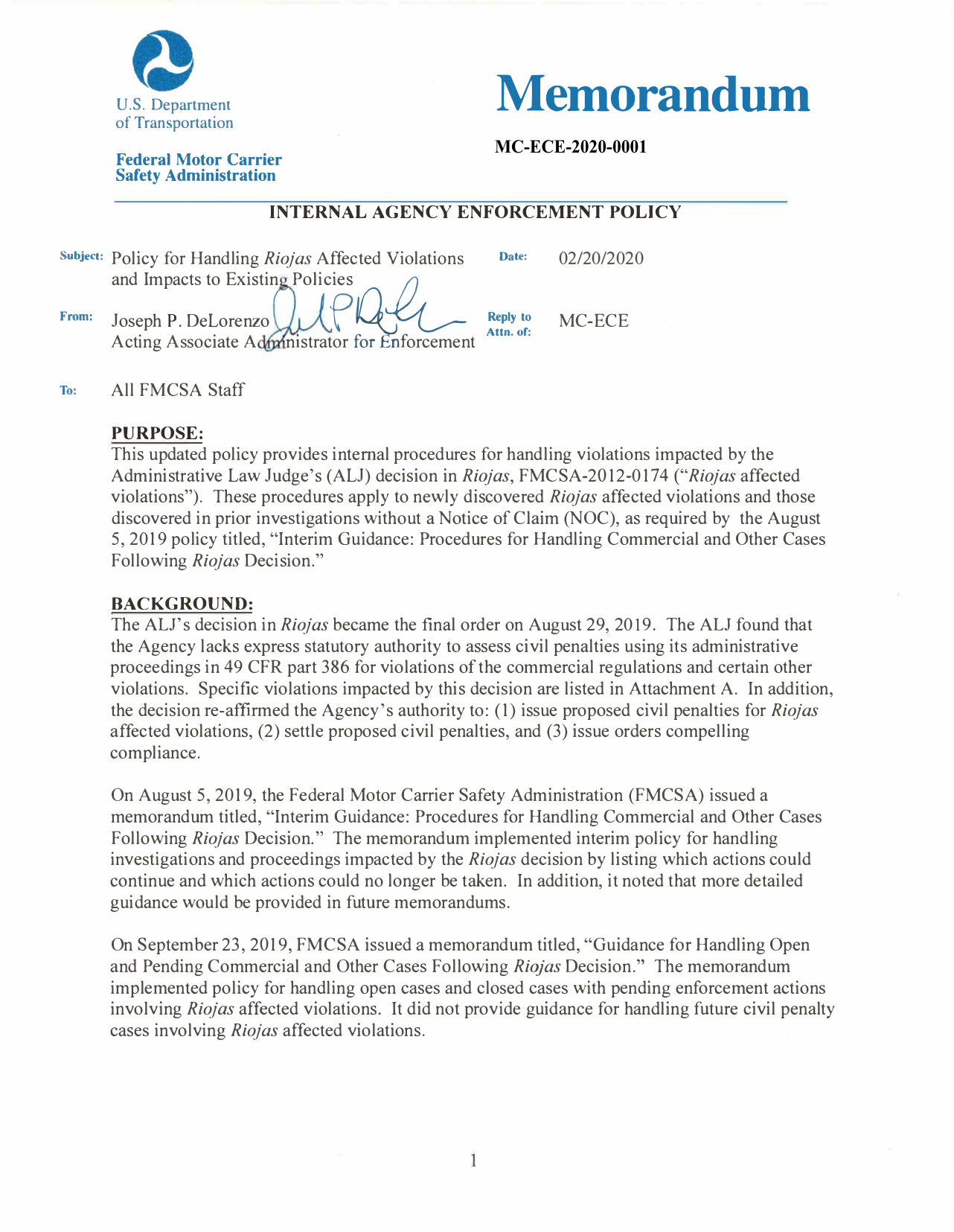
FMCSA internal enforcement policy (February 2020): the agency's own documentation of how the Riojas decision dismantled its household goods enforcement tools.
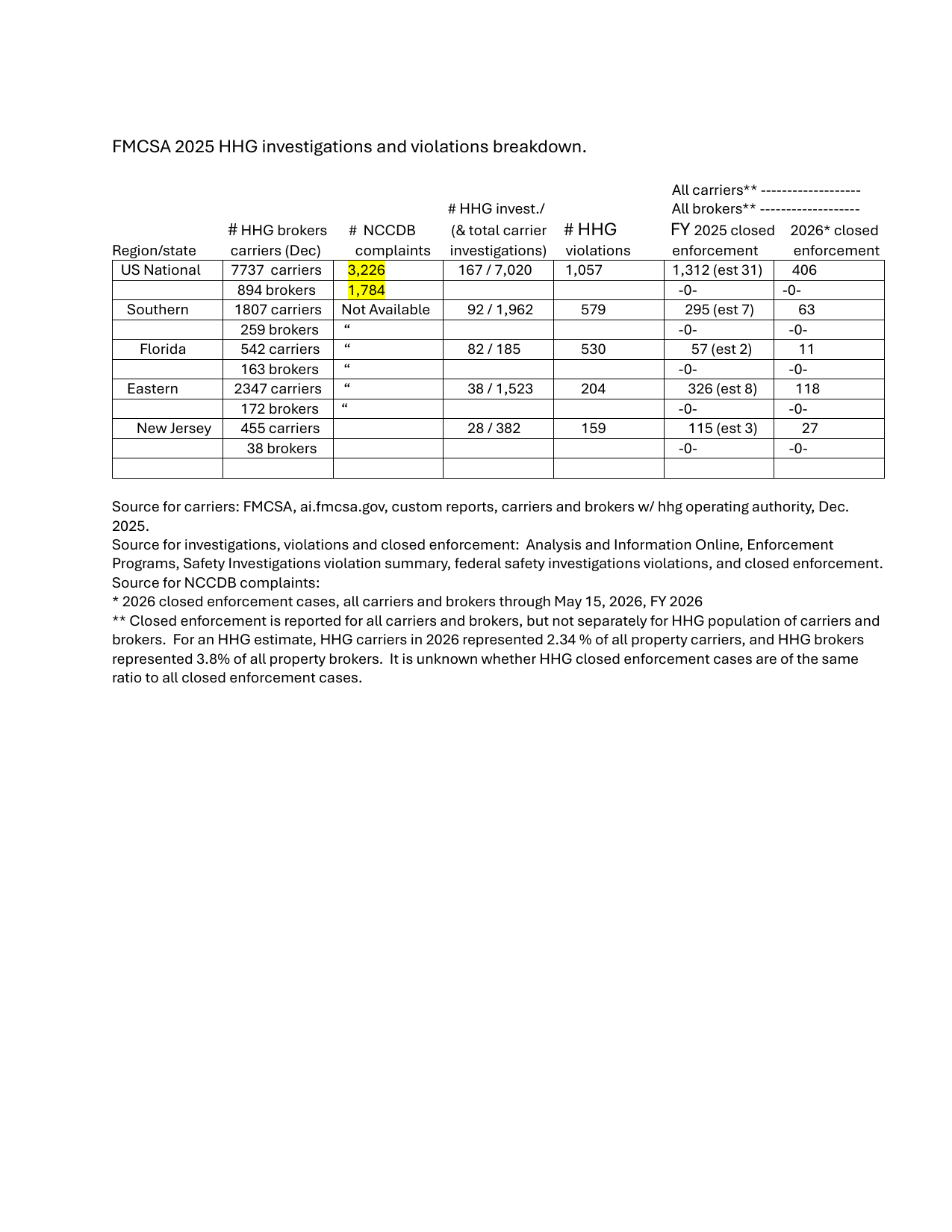
FMCSA data: 7,020 carrier investigations in 2025, only 167 were HHG carriers. 13 total broker enforcement cases in seven fiscal years, zero since FY 2024. Source: FMCSA Analysis and Information Online.
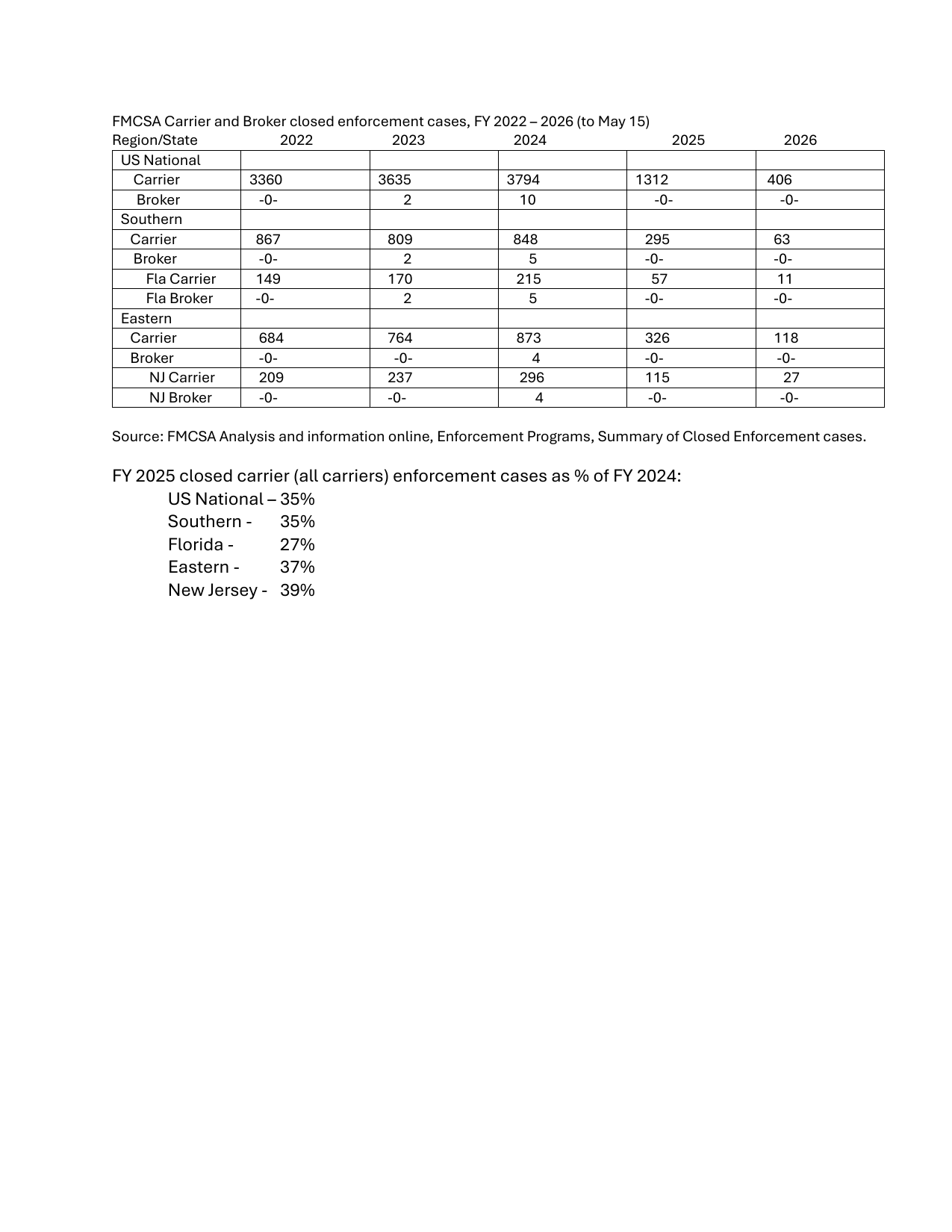
Closed carrier enforcement cases collapsed from 3,794 (FY 2024) to 1,367 (FY 2025) to 750 through 7/31 of FY 2026. Broker enforcement: 13 total cases in seven years, zero since FY 2024. Source: FMCSA Enforcement Programs.
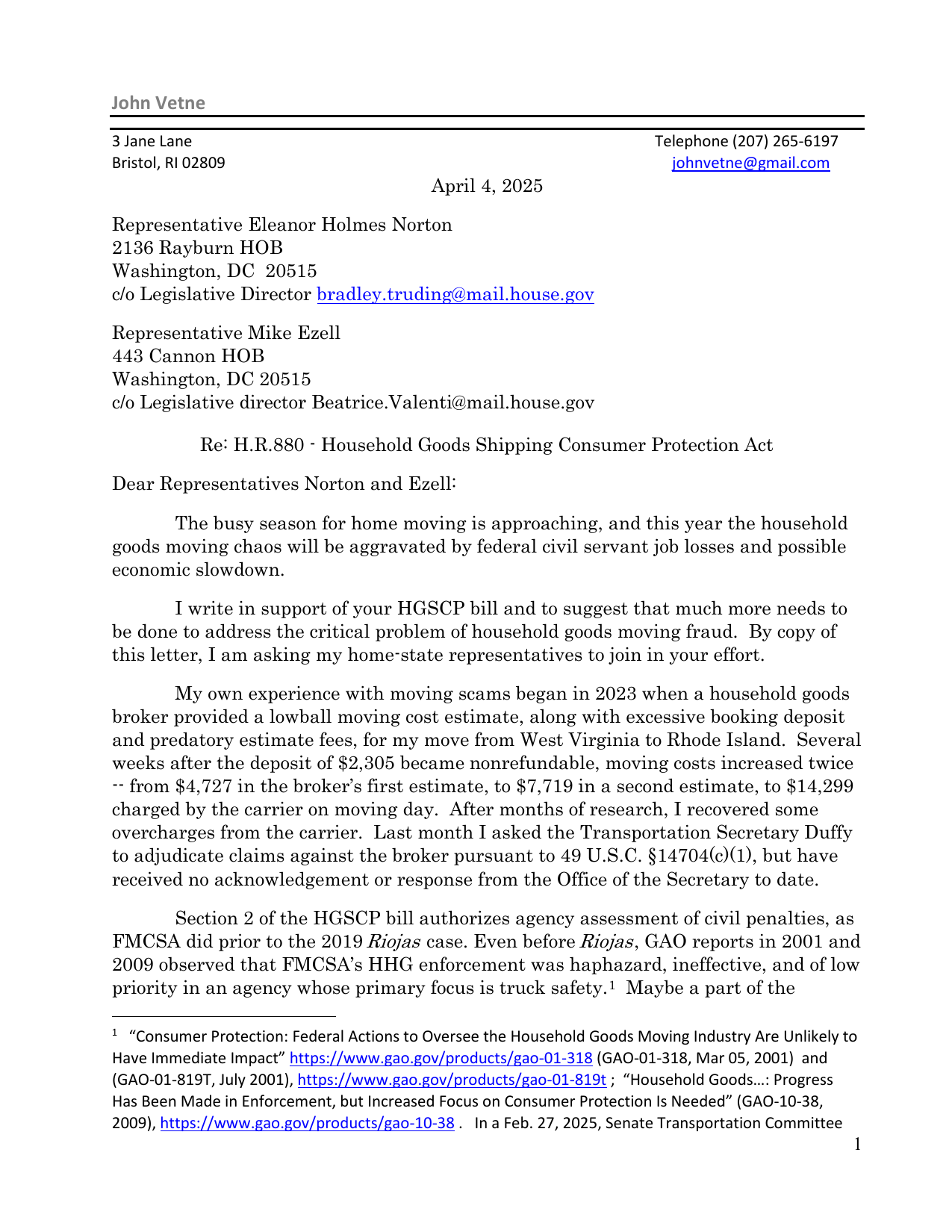
Letter to Representatives Norton and Ezell supporting H.R. 880, the Household Goods Shipping Consumer Protection Act. The bill would restore FMCSA civil penalty authority stripped by the 2019 Riojas decision.
Companies Mentioned
Contributors: John H. Vetne
Sources: FMCSA SAFER database. FMCSA complaint data (FMCSA's complaint intake process). Surface Transportation Board, Section 14704 of the Interstate Commerce Act. FOIA responses. Trunk mover database (4,200+ carriers tracked). Expert interviews with legal professionals specializing in moving fraud. Facebook community groups including "Moving? Tips on moving & avoiding Moving Scams.". AGOYU Moving Guides, "Moving Scams: Confronting Ongoing Consumer Hardships Amidst Token Federal Crackdowns" (2024).