Penske Trucks, No DOT Numbers, No Reply: How Rental Companies Enable Moving Fraud
Rogue carriers with 1 registered truck run fleets of rental vehicles invisible to FMCSA's safety system. Penske knows repeat renters are a problem. It has not addressed how its trucks are used for hostage loads.
Howards Vanlines is registered with FMCSA as a one-truck household goods carrier based in Garfield, New Jersey. It has 166 NCCDB complaints, 158 in 2026 alone. Consumers have tracked stolen goods to a warehouse at 30 Sherwood Lane in Fairfield, NJ. Independence, Missouri, police referred a case to the FBI.
Howards does not move household goods with one truck. Consumer reports document Penske rental trucks arriving for pickups and deliveries. The trucks do not display the carrier's name or DOT number. They are not equipped with the electronic logging devices required for commercial motor vehicles. They are invisible to FMCSA's Safety Measurement System.
This is not unique to Howards. Trunk's analysis of NCCDB complaint data found that carriers with per-truck complaint rates above 50 (meaning 50+ complaints per registered truck) are almost certainly using rental fleets. The top offenders: Howards Vanlines (166 per truck), Handle With Care Moving (147 per truck), Value Added Moving (135 per truck). These are not one-truck operations. They are rental-truck operations hiding behind a one-truck registration.
What Penske Knows
On January 22, 2026, Penske sent an internal email to its rental agent partners implementing a new system to detect 'repeat household consumer rental activity.' The system blocks customers who rent more than five times in 12 months under a household rental agreement, forcing them to convert to commercial accounts.
The email described this as 'ensuring they use the correct rental contract' and 'protecting both agents and Penske from potential risk associated with past-due or high-risk rental activity.' It emphasized the change was 'not about turning customers away.'
But the pattern Penske is flagging, repeated household rentals by the same phone number, is exactly how rogue carriers operate. A one-truck HHG carrier renting Penske trucks five or more times a year under household contracts is almost certainly using those trucks for commercial moving operations without proper DOT registration, vehicle marking, ELD compliance, or insurance coverage.
Penske's own website acknowledges the regulatory requirements: trucks used for interstate commerce need DOT numbers, commercial carriers need MC numbers, and most commercial rentals require ELDs. The gap is enforcement. Penske is directing repeat renters to commercial accounts, but it is not reporting the pattern to FMCSA or refusing service to carriers known to use rentals for fraud.
The Letter That Got No Reply
On June 19, 2026, John Vetne, a retired attorney working on behalf of multiple consumer-shippers victimized by household goods fraud, wrote to Penske Logistics' Associate General Counsel identifying specific Penske rental trucks used by Howards Vanlines for hostage goods operations.
The letter cited two Penske trucks by license plate number: one used for a February 27, 2026 pickup in Northern Indiana, and another used for an aborted delivery in Philadelphia on June 13, 2026 where the shipment was taken hostage and diverted to an undisclosed location.
Vetne asked three questions: (1) What information can Penske provide about the renters and rental transactions? (2) What Penske official should consumers contact when this happens? (3) What policies govern rentals to persons using trucks for FMCSA-regulated household goods carriage?
As of publication, Penske has not responded to the letter.
The SMS Blind Spot
FMCSA's Safety Measurement System (SMS) tracks carrier safety through vehicle inspections, crash records, out-of-service violations, and driver fitness scores. A carrier with poor SMS scores can be flagged for enforcement.
None of this applies to rental trucks. When a Penske truck rented by Howards Vanlines is involved in an incident, the vehicle is not in Howards' SMS profile. Roadside inspections of rental trucks may not link back to the carrier operating them. Crash records may be attributed to the rental company, not the carrier.
This creates a perverse incentive. A carrier that owns its trucks has those trucks inspected, tracked, and scored. A carrier that rents trucks operates outside the safety system entirely. The carrier with the worst complaint record in New Jersey (166 complaints) has one registered truck and no SMS exposure on the dozens of rental trucks it actually uses.
FMCSA's own commercial vehicle requirements, documented on Penske's website, state that rental trucks used for interstate commerce must have DOT numbers, display the carrier's name and DOT number, and comply with ELD mandates. Consumers report that none of these requirements are met when rental trucks arrive for HHG pickups.
What This Means
Rental truck companies are part of the infrastructure that enables moving fraud. This does not mean Penske or U-Haul or Ryder are intentionally facilitating fraud. It means their trucks are being used for purposes that violate federal regulations, and the companies have not implemented controls sufficient to prevent it.
Penske's January 2026 email shows the company is aware that repeat household renters are a pattern worth flagging. The solution, converting them to commercial accounts, addresses Penske's contractual exposure but does not address the consumer harm. A rogue carrier renting under a commercial contract can still use the truck for hostage loads. The DOT number still won't be displayed. The ELD still won't be installed.
For consumers, the takeaway is simple: if a rental truck (Penske, U-Haul, Ryder, Budget) shows up for your move instead of a truck with the carrier's name on it, that is a red flag. It means the carrier does not own the vehicle it is using to transport your belongings. It may mean the carrier is operating outside FMCSA's safety system. And it almost certainly means the truck is not compliant with federal marking and logging requirements.
Document the truck: take photos of the vehicle, note the rental company name and license plate, and include this information in any complaint you file with FMCSA.
Evidence
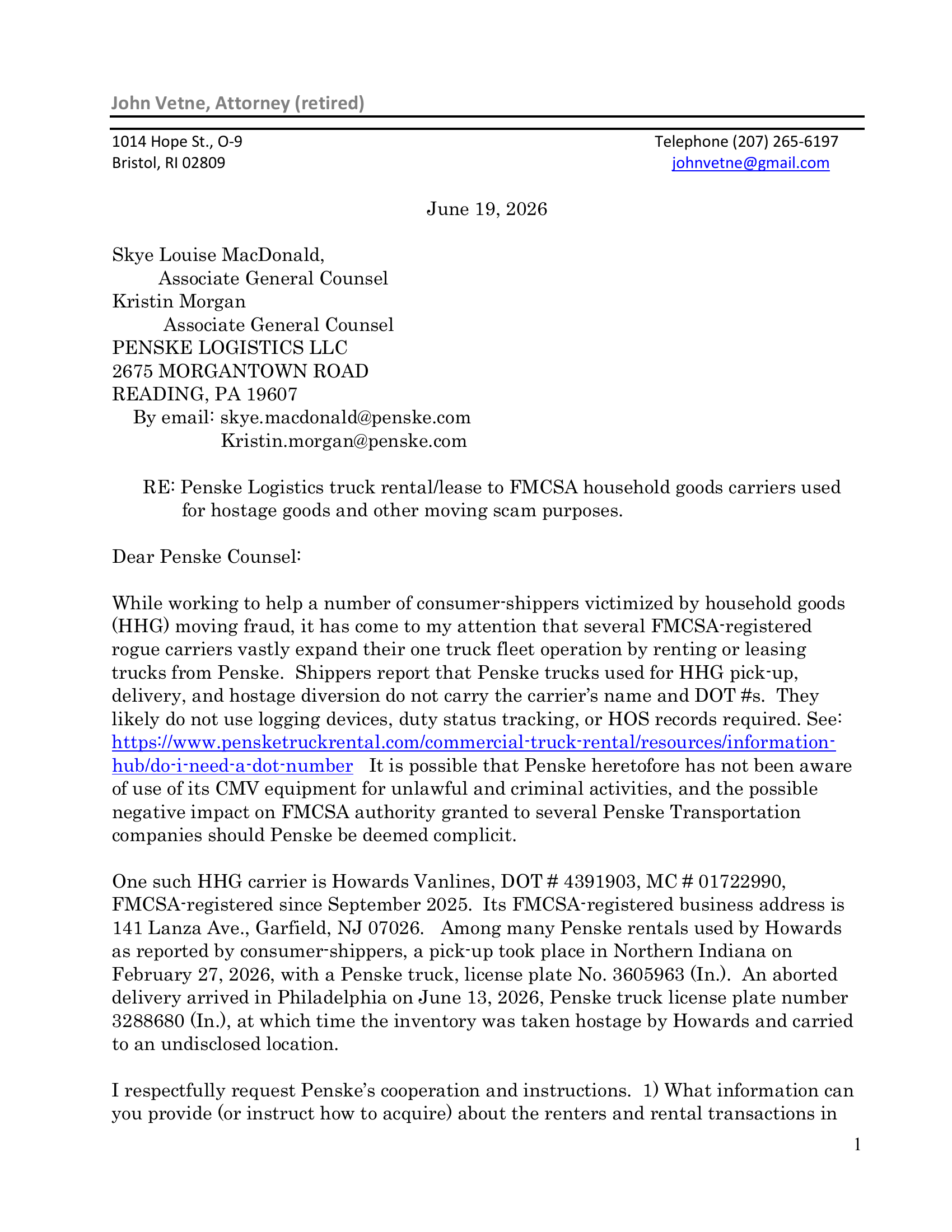
June 19, 2026: Letter to Penske's legal team identifying specific rental trucks by license plate number used by Howards Vanlines for HHG fraud, including a hostage goods incident. No response received.
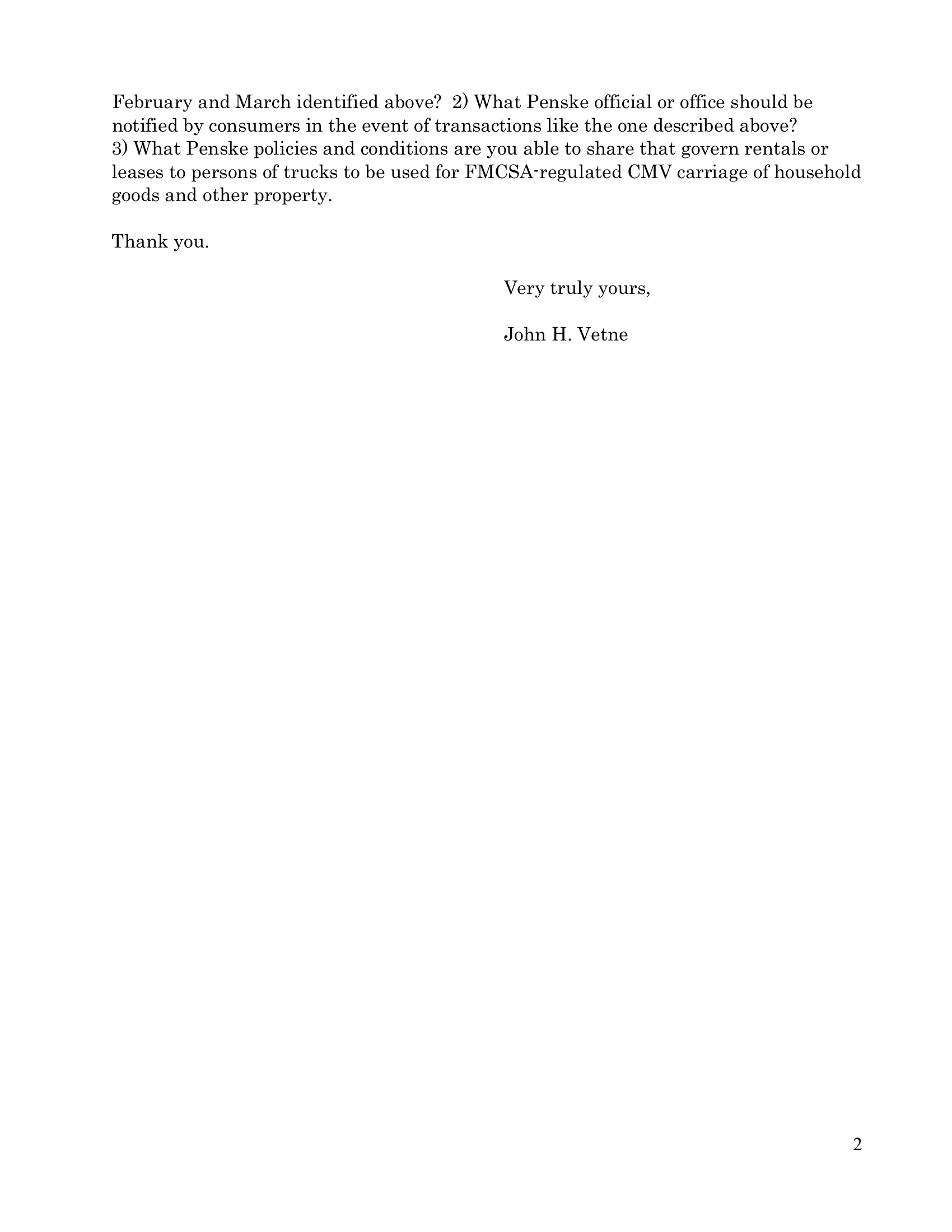
The letter asked three questions: what information can Penske provide, who should consumers contact, and what policies govern rentals for FMCSA-regulated household goods carriage.
Companies Mentioned
Contributors: John H. Vetne
Sources: FMCSA NCCDB complaint data via Trunk scraper (23,789 companies, 51 states). Penske Truck Rental commercial requirements (pensketruckrental.com/commercial-truck-rental/resources/information-hub/do-i-need-a-dot-number). Penske internal email to agent partners re: repeat household consumer rental activity, January 22, 2026. John Vetne letter to Penske Logistics LLC Associate General Counsel, June 19, 2026. KMBC 9 Kansas City investigative reports on Howards Vanlines, June 2026.