The One-Truck Problem: When Your Mover Is a Broker in Disguise
Small carriers that rent trucks and subcontract moves are one of the most common sources of moving fraud.
The Pattern
One-truck carriers take bookings beyond capacity. When overbooked, they rent from U-Haul or Penske. The rental truck arrives with day laborers who bypass FMCSA safety protocols, drug testing, and insurance requirements. The consumer hired a licensed carrier but got an unlicensed crew.
This is not an edge case. It is one of the most common fraud patterns in the household goods moving industry. The carrier maintains a single truck for inspections and legitimacy, then scales operations using rental vehicles and temporary labor. The result: consumers who did their due diligence, checked the USDOT number, read the reviews, still end up with an unvetted crew handling their belongings.
Carrier on Paper, Broker in Practice
Many one-truck operators function as brokers without broker authority. They take your deposit, farm out the move, and take a cut. The company that shows up is not the company you researched. Your contract may have fine print transferring liability to the subcontractor.
FMCSA draws a hard line between carriers (who physically transport goods) and brokers (who arrange transportation). Each requires separate authority and separate insurance. When a one-truck carrier subcontracts your move to another crew, they are acting as a broker without the legal authority, the bond, or the consumer protections that broker registration requires. If something goes wrong, you may discover that the company you hired claims no responsibility for the crew that actually moved you.
How to Spot It
There are several reliable indicators that your mover may be operating this way. A rented truck on moving day is the most obvious, with Budget, Penske, or U-Haul branding visible on the vehicle. The crew doesn't know the company name when asked. There are no branded uniforms or equipment. The crew asks you to sign paperwork with a different company name than the one you booked. The quote came by phone only with no in-home or video survey.
Any one of these signals warrants concern. Multiple signals together are a strong indicator that the carrier you hired is not the operation that showed up.
What Trunk's Data Shows
Trunk tracks over 4,200 movers and has documented the one-truck rental pattern across the DMV and California markets. Multiple movers in our database use rented trucks, documented in photos collected during research. We flag "uses rented trucks" as a data point on mover profiles so consumers can see it before booking.
When we see a Google review mentioning a different company showed up than the one booked, we investigate. Cross-referencing eight sources (FMCSA records, Google, Yelp, BBB, Reddit, Facebook community groups, MovingScam.com, and expert interviews) lets us identify patterns that no single source would reveal. A mover with one Google complaint about a rental truck might be a one-time situation. The same mover with rental truck mentions across Google, Yelp, and Reddit is a pattern.
How to Protect Yourself
Ask for the USDOT number and verify at safer.fmcsa.dot.gov. Ask whether they own their trucks or rent. Get a binding estimate based on an in-home or video survey, not a phone call. On moving day, check that the truck matches the company you hired. The truck should display the carrier's name and USDOT number on the side, as required by federal law.
If a different company shows up, document everything. Photograph the truck, the crew, and any paperwork they ask you to sign. If you feel comfortable refusing the move, do so. If your belongings are already loaded, call FMCSA at 1-888-368-7238 to report the situation while it is happening.
The Census: Half the Industry Operates With One or Two Trucks
FMCSA registration data as of May 2026 shows 4,586 licensed household goods carriers nationally. Of these, 1,347 (29%) report a fleet of one truck, and 801 (17%) report two trucks. Nearly half of all licensed HHG carriers in the United States operate with one or two vehicles. In 2025 alone, 284 new HHG carriers were registered. This one-truck and two-truck segment is where the 'carrier on paper, broker in practice' model thrives. When a single-truck carrier takes multiple bookings, the overflow is subcontracted to whoever is available, often without disclosure to the consumer. These same carriers are the most likely to rent from Penske, U-Haul, or Budget for overflow work, staffing the rental with day laborers who bypass FMCSA safety protocols. The scale of the problem is not a few bad actors. It is a structural feature of an industry where almost half of licensed carriers are micro-operations with minimal oversight.
Evidence
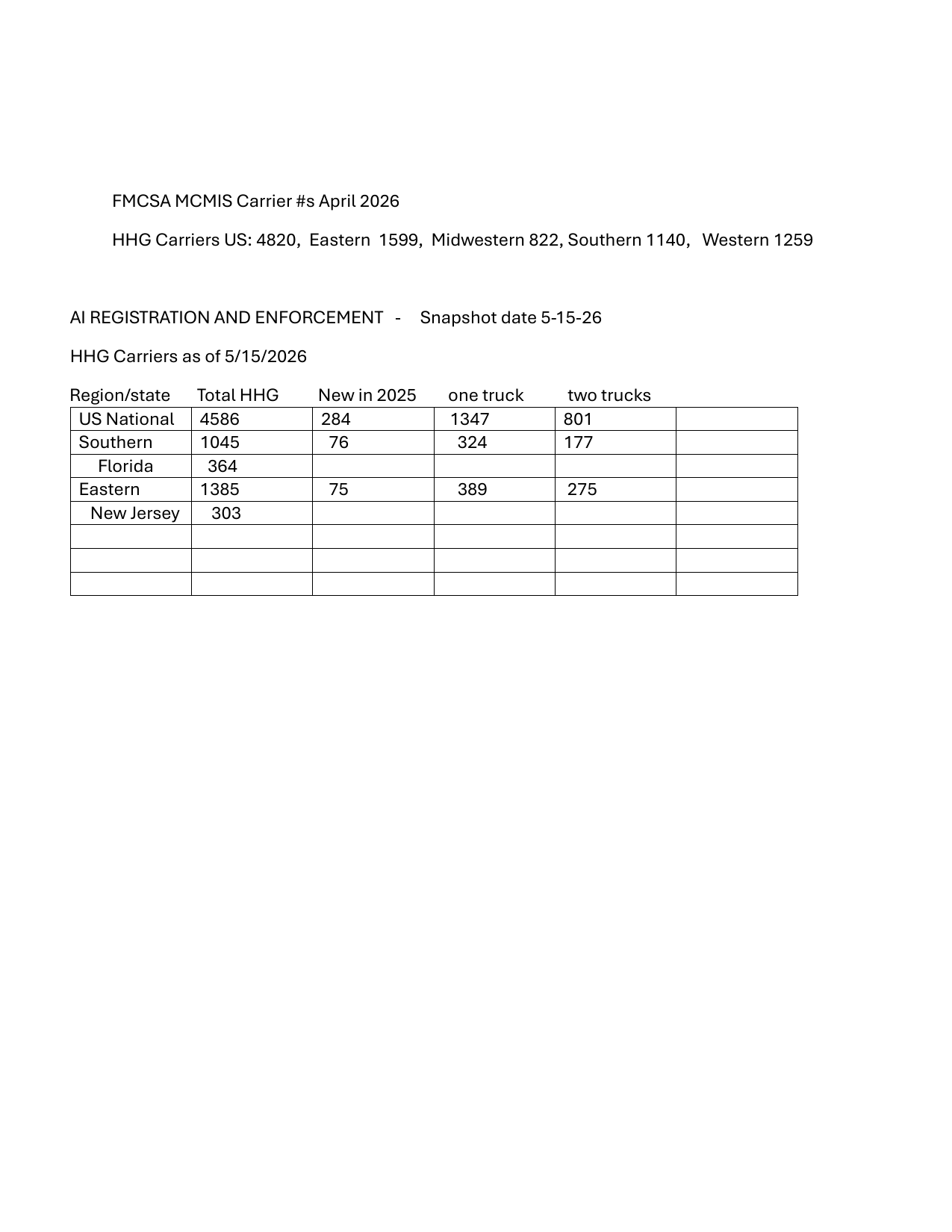
FMCSA registration data: 1,347 of 4,586 HHG carriers (29%) have one truck. 801 (17%) have two trucks. Nearly half the industry operates with minimal fleet. Source: FMCSA MCMIS, May 2026.
Sources: Trunk mover database (4,200+ carriers tracked). FMCSA SAFER database. Consumer reviews across Google, Yelp, BBB, Reddit, and MovingScam.com. Trunk field research, 2025-2026. Facebook community groups including "Moving? Tips on moving & avoiding Moving Scams."